Em resumo
Nível da classe :6º ano EF
Tipo :Audiolivros
Eixos culturais :Pessoas e Personagens, Vida Cotidiana, Países e Paisagens, Imaginação & Lendas


 y
y
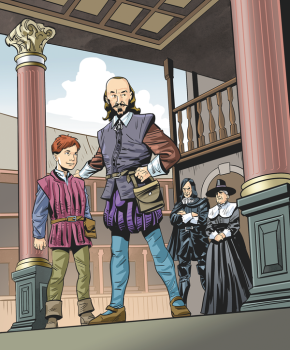
Transport your students to the bustling London of Shakespeare with this captivating historical mystery! "Shakespeare and the Shoemaker" is an audio story that blends adventure, mystery, and culture. Students will follow Edmund, a clever young hero who uses his unique talent to solve an investigation. It is an excellent resource for working on aural comprehension of a suspenseful plot, while also discovering the world of the greatest English playwright.
Nível da classe :6º ano EF
Tipo :Audiolivros
Eixos culturais :Pessoas e Personagens, Vida Cotidiana, Países e Paisagens, Imaginação & Lendas
Para baixar este material, você deve estar logado com uma conta de professor registrada na Olimpíada The Big Challenge.
Objetivo & Resumo da Trama
Objetivo: Levar os alunos a seguir uma investigação em inglês, a identificar suspeitos a partir de pistas sonoras e a compreender a resolução de um mistério.
Resumo: Na Londres do século XVI, um jovem aprendiz de sapateiro com memória fotográfica encontra seu herói, William Shakespeare. Quando o final de Romeu e Julieta é destruído em um incêndio suspeito, Edmund usa sua astúcia e talento para prender o culpado entre três suspeitos e salvar a peça.
Desenvolvimento Sugerido
1. Antes de ouvir (~10 min): MERGULHAR NA LONDRES DO SÉCULO XVI
Antecipação: Mostrar a ilustração dos personagens e do mapa (página 3). Quem é Shakespeare? Onde a ação se passa?
Vocabulário: Introduzir as palavras da investigação: fire, suspect, guilty (culpado), trap (armadilha).
2. Durante a audição (~25 min): SEGUIR A PISTA
Audição fragmentada em 3 etapas:
Parte 1 (Os suspeitos): Ouvir até o final das visitas de Greenaway, Benson e Hardcastle. Pausa: "Who is angry at Shakespeare? Why?".
Parte 2 (O crime): Ouvir até a descoberta do incêndio criminoso. Pausa: "What happened? Who are the three suspects?".
Parte 3 (A resolução): Ouvir o plano de Edmund e o desfecho.
3. Após a audição (~15 min): RESOLVER A INVESTIGAÇÃO
Discussão: "Who was the guilty person? Why did he do it? Was Edmund's plan clever?".
Tarefa simples: Formar 3 grupos, um para cada suspeito. Cada grupo prepara uma frase para clamar sua inocência ou acusar outro. Exemplo: "I am Dame Hardcastle. I am not guilty. I think the actor did it!".
Adaptações
Para simplificar: No quadro, criar uma ficha "Suspeitos". Após ouvir a apresentação de cada suspeito, fazer uma pausa e anotar o nome deles e a razão de sua raiva (o motivo).
Para aprofundar: Pedir aos alunos para imaginarem ser Shakespeare. Eles escrevem uma curta nota em seu diário para contar sobre o incêndio e seu encontro com o "notável" Edmund.
absent-minded (adj.) If you are absent-minded, you often forget things.
absurd (adj.) without any meaning an afternoon off an afternoon when you don’t have to work
apprentice (n., v.) an apprentice is a young person who is learning a specific job from an older, experienced person
ashes (n.) what is left of wood, paper or coal after a fire
astounded (adj.) extremely surprised be on the throne A King or a Queen sits on a throne.
blank (adj.) with no writing on
bright (adj.) clever, intelligent, quick to learn
can’t stand (v.) If you can’t stand something, you hate it!
cloth (n.) material (cotton, wool, etc.)
constable (n.) in the 16th century, a sort of policeman
corridor (n.) a passage between two rooms, for example
crypt (n.) a room underneath a church where people are buried
dagger (n.) a sort of knife
deliver (v.) If you buy something on the Internet, someone will deliver it to your house.
devil (n.) an evil force or person, the opposite of God do harm to hurt, to cause problems for
edge (n.) the outside limit of something
entertain (v.) to amuse, to give pleasure to get their way to obtain what they want
guilty (adj.) responsible (for a crime)
Heaven (n.) Paradise
leather (n.) the skin of an animal (usually a cow) used for clothes, shoes or bags, for example
magistrate (n.) a judge
manuscript (n.) a text that someone wrote by hand
orphanage (n.) a home for children without parents
part (n.) (here) role in a play or a film
playwright (n.) a person who writes plays
Puritan (n.) The Puritans were a group of English Protestants in the 16th and 17th centuries who wanted to impose strict rules on people’s lives.
rubbish (n.) something with no value, something you throw away run errands to take messages, go shopping, etc.
sheet (n.) A sheet of paper is a large piece of paper – a page.
sigh (v.) When you sigh, you make a soft sound, like “Aaah”.
stage door (n.) The stage is where the actors perform. The back door of a theatre, used by the people who work in the theatre, is the stage door.
storm out (v.) to leave quickly and angrily
suspect (n.) a person you think is responsible for a crime
tear up (v.) to pull apart with force
threaten (n.) to menace, to intimidate
trap (n.) a trick to make someone do something they don’t intend to do
triumphantly (adv.) in a way that shows victory
trust (v.) to have confidence in
ungodly (adj.) against the rules made by God
useless (n.) If something is useless, it doesn’t work or is impossible to use.
warn (v.) to inform someone in advance of a possible danger
widower (n.) a man whose wife is dead
Please wait...