Can / can't
Interaktywne ćwiczenia, aby utrwalić kompetencje Twoich uczniów.
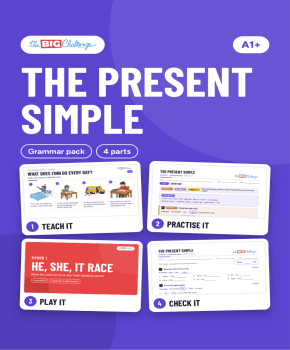
Everything to teach can and can't: slides to project, a three-level practice sheet, a team game and a 10-minute quiz with answers. Four friends and their talents start the lesson; pupils then learn can and can't, Can ...? questions with short answers, What can ...? and how well (very well, well, not at all). For A0+ to A1+, two lessons of about 45 minutes.
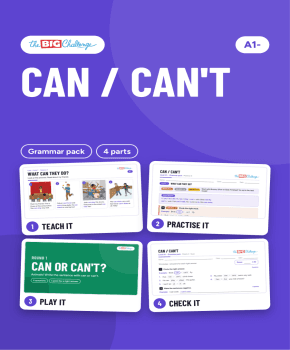
Dokumenty do pobrania (4)
- Teach it: lesson slides Na Twoim koncie nauczyciela
- Practise it: three-level sheet Na Twoim koncie nauczyciela
- Play it: team game Na Twoim koncie nauczyciela
- Check it: quiz and key Na Twoim koncie nauczyciela
Przewodnik dydaktyczny
Objective & content
Everything to teach can and can't in one pack of four parts: slides to project, a three-level practice sheet, a team game and a 10-minute quiz with answers. The pack starts from a short picture story, four friends and their talents (Grace sings, Callum catches three balls, Jade plays the drums, Mei skates but Oscar can't), in which pupils notice the form before they meet the rule. It then covers can and can't for ability, the mistakes to avoid (no -s, no to), questions with Can ...? and short answers, What can ...?, and how well (very well, well, not very well, not at all). By the end, pupils can say and write what people can and can't do, ask about it, and say how well.
Pedagogical guide
The rule is given in Remember! boxes, not left to be deduced; the story and the pictures make the form easy to notice first. The practice sheet is one A4 sheet at three levels: every page has a Bronze, a Silver and a Gold task, so the whole class works on the same page and each pupil moves up when they finish. The game puts the same language under time pressure, in four rounds, and the quiz gives a mark out of 20. The pack stays at A1- level: can and can't for ability only, with no past simple, no do-questions, no could and no will. The key page of the practice sheet holds the answers, teacher notes and the common mistakes (for example "She cans swim" and "I can swim very good"). Spelling is British English.
Suggested procedure
The pack fits two lessons of about 45 minutes. Lesson 1 is Teach it and Practise it; lesson 2 is Play it and Check it. The four parts can also be used alone.
- (25 min) Teach it (lesson.pdf, lesson 1): show the story and ask "What can Grace do?", read the Remember! boxes aloud, practise how well with the class, then do the quick check together. The last slide is for the teacher and is not projected.
- (20 min) Practise it (practice.pdf, lesson 1): give each pupil the three pages and a start (Bronze, Silver or Gold); correct page by page, with one pupil from each medal reading an answer.
- (20 min) Play it (game.pdf, lesson 2): make teams, show each question, give 20 seconds to write the answer, then show the answer slide and keep the score. Round 4 is worth double points.
- (10 min) Check it (quiz.pdf, lesson 2): pupils work alone on page 1; mark out of 20 with page 2.
Adaptations
[S] Start every pupil at Bronze and keep the Remember! slides on screen during the practice and the game. Accept a short answer in the game and do the quiz in two halves.
[A] Send fast pupils straight to Gold and then to the Gold writing task on page 3, where they write about themselves and read it to a partner who asks one Can ...? question. In the game, ask them to say each answer aloud in a full sentence.
Materials & prerequisites
A projector or screen for lesson.pdf and game.pdf (one PDF page per slide, turned with the arrow keys), and paper for the teams' answers. Print practice.pdf (3 pages for pupils; the key page is for the teacher) and quiz.pdf (page 1 for pupils, page 2 is the key), one copy per pupil. Pupils should already know be and have got and basic everyday verbs such as sing, play, swim and run. It goes well early in a first year of English, before work on the present simple with do and does.
Możliwe adaptacje
- Słabsze poziomy: zaproponuj słuchanie partiami i dodatkowe materiały wizualne.
- Poziomy zaawansowane: zachęć do ustnego streszczenia i debaty po angielsku na ten temat.
- Liczne klasy: zorganizuj pracę w grupach ze zróżnicowanymi rolami.
🔒 Treść zastrzeżona
Ten zasób wymaga abonamentu, aby z niego skorzystać.
Odblokuj zasóbW cenie abonamentu