Reading B1+: Is Your Cat Secretly Loyal?
Interaktywne ćwiczenia, aby utrwalić kompetencje Twoich uczniów.
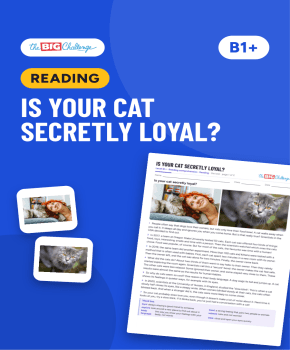
A B1+ reading about cats and their owners: what three studies found when scientists tested whether cats really love the people they live with. One text with a word box, ten questions and a group speaking task, cats or dogs, plus an answer key; 30 to 40 minutes.
Dokumenty do pobrania (2)
- Reading comprehension Na Twoim koncie nauczyciela
- Reading comprehension (black and white) Na Twoim koncie nauczyciela
Przewodnik dydaktyczny
Objective & content
A B1+ reading that tests a common idea: dogs love their owners, but cats only love their food bowl. The text presents three studies. At Oregon State University, cats chose between food, toys, smells and time with a person, and most of them chose the person. In a second test, often used with babies, about two thirds of the cats showed a "secure" bond with their owner, almost the same result as human babies. At the University of Sussex, scientists studied the "slow blink", a cat's quiet way of showing its feelings. The text ends on a smile: if your cat blinks back, you've just had a conversation with a cat. By the end, pupils can follow a short popular-science text, describe an experiment in steps, and compare two pets with reasons. It is part of the Reading B1+ set: one-text readings with the same layout.
Pedagogical guide
The sheet has one text of about 350 words at B1+, with no sentence longer than 20 words, and a word box with six words explained in English (loyal, bond, explore, relaxed, body language, blink). The ten questions go from finding information to explaining it: three choices or true or false first, then "How was the 2019 experiment done? Describe the three steps." and "Why do you think many people believe that cats don't love their owners?" The text models the passive (each cat was offered, more than 100 cats were tested, a method that is often used) and the linkers although, even though and so. The speaking task puts them to work: in groups, pupils decide which pet makes the better friend, with "Although cats ..., they ..." and "Dogs are often seen as ...". Every fact comes from published research on cats.
Suggested procedure
- (5 min) Warm-up: show the two photos and ask "Do you think cats love their owners? How can you tell?"
- (10 min) Pupils read the text alone. They can use the word box.
- (10 min) Pupils answer questions 1 to 10, then check in pairs. Correct together with the key; for 9 and 10, take two or three answers.
- (10 to 15 min) Speaking task: in groups, pupils decide which pet makes the better friend, a cat or a dog, find two reasons for each, then tell the class their choice.
Adaptations
[S] Go through the word box first. Before question 9, read paragraph 3 again together and underline First, Then, Finally. Pupils can answer questions 1 to 8 only, and give one reason in the speaking task.
[A] Pupils write a short paragraph, "Cats or dogs?", using although, even though and two passive sentences. They can also try the slow blink with a cat at home and report what happened.
Materials & prerequisites
The sheet in colour or low ink (the low-ink version has no pictures), one copy per pupil: pages 1 and 2 are for pupils, page 3 is the answer key. A screen to show the photos for the warm-up. Pupils should know the past simple and have met the passive.
Możliwe adaptacje
- Słabsze poziomy: zaproponuj słuchanie partiami i dodatkowe materiały wizualne.
- Poziomy zaawansowane: zachęć do ustnego streszczenia i debaty po angielsku na ten temat.
- Liczne klasy: zorganizuj pracę w grupach ze zróżnicowanymi rolami.
🔒 Treść zastrzeżona
Ten zasób wymaga abonamentu, aby z niego skorzystać.
Odblokuj zasóbW cenie abonamentu