Around the Clock
Zasób dydaktyczny pomyślany, by dodać energii Twoim lekcjom angielskiego.
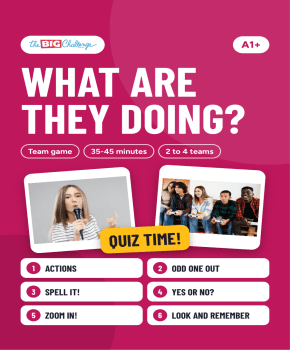
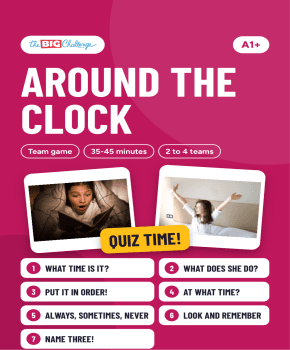
Pupils play a projected team quiz on daily routine, telling the time, the present simple (he / she + -s) and adverbs of frequency, with real photos: 2 to 4 teams go through seven rounds (What time is it?, What does she do?, Put it in order!, At what time?, Always, sometimes, never, Look and remember and Name three!) and write full sentences such as "It's half past seven." or "She brushes her teeth.", using the verbs of a typical day. 37 questions, 46 points, each question followed by its answer slide. For A1+, about 35 to 45 minutes.
Dokumenty do pobrania (1)
- Wersja kolorowa Na Twoim koncie nauczyciela
Przewodnik dydaktyczny
Objective & content
A projected team quiz on daily routine, telling the time, the present simple (he / she + -s) and adverbs of frequency, with real photos, for one game of 35 to 45 minutes. The class plays in 2 to 4 teams through seven rounds: What time is it? (a wall clock; teams write a full sentence such as "It's half past seven."), What does she do? (a photo of a teenager's routine; teams write "She brushes her teeth." or "He watches TV."), Put it in order! (four photos of a morning, an afternoon or a day; teams write the letters in the right order; 2 points), At what time? (a sentence with a gap and the verb in brackets: "He ___ (do) his homework at half past four."), Always, sometimes, never (three sentences, only one has the adverb in the right place), Look and remember (20 seconds to look at six photos, then one photo goes and teams say what is missing) and Name three! (three things you do in the morning, in the evening and at school). There are 37 questions and 46 points. Pupils meet the verbs of a typical day and the times of the clock.
Pedagogical guide
Every question slide is followed by its answer slide, so the class sees the answer at once and the teacher only keeps the score. This quiz tests the time (o'clock, half past, quarter past, quarter to), the present simple with he / she (the verb takes -s: gets up, brushes, has, does, goes, watches) and the place of adverbs of frequency, and teams write sentences, not single words: accept any correct sentence, with or without the contraction ("It's half past seven." or "It is half past seven."). The photos are real teenagers at home and a real wall clock, so pupils describe what they see. In What time is it? the word bank stays on the screen, so pupils concentrate on the clock; the last question is a bonus: they look at the alarm clock and say when he wakes up. What does she do? is the heart of the game: the answer slide points out the tricky verbs (have → has, do → does, watch → watches), and with they there is no -s, which catches many pupils. Put it in order! is worth 2 points for the right order, and pupils can use "First, he wakes up. Then he gets up. After that...". At what time? is a gap: pupils write the verb in the right form, and the time in the sentence reminds them of the clock. Always, sometimes, never gives three sentences and only one is right; the answer slide says why (the adverb goes before the verb, but after be: he is never late). Look and remember shows six photos for 20 seconds, then one goes; teams write a sentence about the missing photo. Name three! accepts any right answer: the answer slide lists the most likely ones, and your pupils may find others. Every round opens with a Useful phrases box: read it with the class before you start, so teams can use it to speak and write. The quiz stays at A1+ level, in British English. Useful language for the teams: "She always gets up at seven.", "He does his homework at half past four.", "I think it's B, because...". To extend the game, add a round where each pupil writes three true sentences about his or her own day ("I usually get up at seven.") and the other teams guess who wrote them.
Suggested procedure
- (3 min) Make 2 to 4 teams and draw a score table on the board. Each team has one sheet of paper and one writer.
- (5 min) Round 1, What time is it?: show the clock and give 20 seconds; teams write a full sentence. Show the answer slide. 1 point for each right sentence, including the bonus question.
- (5 min) Round 2, What does she do?: show the photo; teams write a sentence with the right verb form. 1 point for each right sentence.
- (4 min) Round 3, Put it in order!: show the four photos; teams write the four letters in the right order. 2 points for the right order.
- (6 min) Round 4, At what time?: show the sentence with the gap; teams write the verb in the right form. 1 point for each right answer.
- (5 min) Round 5, Always, sometimes, never: show the three sentences; teams write A, B or C. 1 point for each right answer.
- (4 min) Round 6, Look and remember: show the six photos for 20 seconds, then hide one; teams write a sentence about the missing photo. 1 point for each right answer.
- (5 min) Round 7, Name three!: read the question; teams write three things. 1 point for each right word, up to 3 points a question.
- (2 min) Add up the points on the board and show the last slide to find the winners.
Adaptations
[S] In round 1, do the first clock together and let teams say the time instead of writing it. In round 2, read the verbs in the word bank aloud with a mime for each one before you start. In round 6, show the photos for 30 seconds instead of 20.
[A] In round 2, ask teams to add an adverb of frequency ("She always gets up early."). In round 4, ask teams to write the full sentence again with a different time. Add a round where each pupil writes three true sentences about his or her own day and the other teams guess who wrote them.
Materials & prerequisites
A projector or screen for game.pdf (85 slides in 16:9, one PDF page per slide, turned with the arrow keys), the board for the score table, and a sheet of paper and a pen for each team. Pupils should already know the verb be (it is, she is), the numbers up to twelve and a few common verbs such as get up, have and go. The quiz works well as a revision game at the end of a unit on daily routine, telling the time or the present simple, or as a reward at the end of a lesson.
Możliwe adaptacje
- Słabsze poziomy: zaproponuj słuchanie partiami i dodatkowe materiały wizualne.
- Poziomy zaawansowane: zachęć do ustnego streszczenia i debaty po angielsku na ten temat.
- Liczne klasy: zorganizuj pracę w grupach ze zróżnicowanymi rolami.
🔒 Treść zastrzeżona
Ten zasób wymaga abonamentu, aby z niego skorzystać.
Odblokuj zasóbW cenie abonamentu