My Year in Emojis
Interaktywne ćwiczenia, aby utrwalić kompetencje Twoich uczniów.
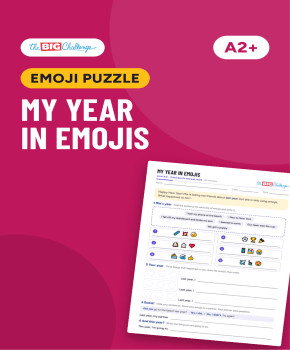
Mia's year in six lines of emojis, from a broken arm to a trip to New York: pupils match each line with a past simple sentence, draw their own year and write "Last year, I ...", then a partner guesses with "Did you ...?"; one page, about 30 minutes at A2+.
Dokumenty do pobrania (2)
- Wersja kolorowa Na Twoim koncie nauczyciela
- Wersja czarno-biała Na Twoim koncie nauczyciela
Przewodnik dydaktyczny
Objective & content
A one-page lesson for the first days back in January: pupils tell last year in emojis and practise the past simple. In part 1, they read Mia's year in six lines of emojis and write the right sentence from the box under each line ("We got a puppy."). In part 2, they draw three emoji lines about their own year and write a sentence with "Last year, I ..." for each one. In part 3, a partner looks at the emojis and guesses with "Did you ...?". In part 4, they write one plan with "I'm going to". About 30 minutes.
Pedagogical guide
The page moves from reading the past simple to writing it, then to asking questions with it. Mia's six sentences are models: they mix regular verbs (learned) and irregular ones (fell, broke, won, got, lost, flew). Part 2 makes the grammar personal, and drawing first gives pupils time to choose what they want to say. Part 3 is a real guessing game: the partner sees only the emojis, so each "Did you ...?" question has a purpose, and the short answers "Yes, I did." and "No, I didn't." are printed on the page. The last line goes back to going to for a plan. Use the page after pupils have met the past simple, as practice or revision. The teacher key is the small line at the bottom of the page.
Suggested procedure
- (3 min) Hand out the page. Read the introduction aloud: Mia is telling her year with emojis only.
- (7 min) Part 1. Do number 1 together (a skateboard, a crash and a hurt face: "I fell off my skateboard and broke my arm."). Pupils write the other sentences, alone or in pairs. Check aloud.
- (8 min) Part 2. Pupils draw three emojis in each box, then write their three sentences. Help with the past forms they need.
- (8 min) Part 3. Pupils hide their sentences and show only their emojis. The partner asks "Did you ...?" questions until the answer is "Yes, I did.", then writes one sentence about the partner.
- (4 min) Part 4. Pupils write one plan for this year. Ask a few pupils to read it aloud.
Adaptations
[S] Write a few useful past forms on the board before part 2 (went, saw, played, visited, had). Pupils may write two sentences, not three.
[A] Pupils cover the box in part 1 and write Mia's sentences from the emojis alone, then compare with the box. In part 3, they write a sentence for each of their partner's three emoji lines.
Materials & prerequisites
One copy per pupil, in colour or in the low-ink version, and a pencil for the drawings. No preparation. Pupils should already know the past simple, with "Did you ...?" questions and short answers.
Możliwe adaptacje
- Słabsze poziomy: zaproponuj słuchanie partiami i dodatkowe materiały wizualne.
- Poziomy zaawansowane: zachęć do ustnego streszczenia i debaty po angielsku na ten temat.
- Liczne klasy: zorganizuj pracę w grupach ze zróżnicowanymi rolami.
🔒 Treść zastrzeżona
Ten zasób wymaga abonamentu, aby z niego skorzystać.
Odblokuj zasóbW cenie abonamentu