I'm not convinced!
Interaktywne ćwiczenia, aby utrwalić kompetencje Twoich uczniów.
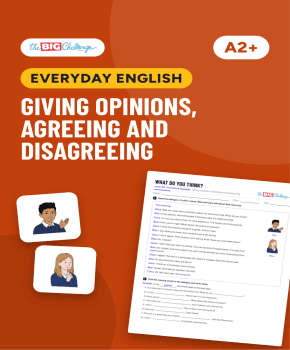
Giving a strong opinion, giving reasons, answering the other side's reasons and persuading someone, seen through Thandi, who wants her friend Casper to vote for the adventure park, not the beach, for their class trip. Pupils find the missing words in the dialogue, read the useful phrases, match situations to phrases, choose the best reply, put a dialogue in order, complete another one and hold a short debate in pairs with reason cards; answer key included.
Dokumenty do pobrania (2)
- Wersja kolorowa Na Twoim koncie nauczyciela
- Wersja czarno-biała Na Twoim koncie nauczyciela
Przewodnik dydaktyczny
Objective & content
This functional language sheet teaches pupils to give a strong opinion (I strongly believe we should choose the adventure park. In my opinion, the beach is better.), give reasons (The main reason is that... What's more,...), look at the other side (On the other hand, the weather might be bad.), answer someone else's reasons (That's a fair point, but... I'm not convinced. I see what you mean.) and persuade (Don't you think that we need something new? OK, you've persuaded me!). Pupils read a dialogue in which Thandi persuades her friend Casper, find the missing words and read the useful phrases, given in a box. By the end, they can defend an idea with two or three reasons, answer the other side and say whether they are convinced.
Pedagogical guide
Page 1 is the dialogue, with a picture of Thandi and of Casper: their class votes on the end-of-year trip tomorrow. Thandi wants the adventure park (climbing, zip wires and mountain bikes); Casper prefers the beach, which is free and only twenty minutes by bus. Thandi answers each of his reasons: a ticket costs £30, but the school is paying half, so it's £15 each; if it rains, they will be cold and wet on the beach, but the park has an indoor climbing wall and a café; and they have been to the beach twice this year. In the end Casper says "OK, you've persuaded me!" and will vote for the park. Pupils find eight missing words in lines from the dialogue. Page 2 has the useful phrases in a box, with the key words in bold, five situations to match to a phrase (disagreeing with a good point, the most important reason, one more reason, wanting a friend to agree, a friend who has changed your mind) and six lines with three replies each, where pupils tick the best one. Page 3 has a dialogue in which Maddie persuades Gideon to cycle to school with her, to number from 1 to 8, and a dialogue about a vegetable garden at school, to complete with six words in a box. The last task is a debate in pairs: should school start at nine o'clock, not eight? Student A is for the idea and Student B is against it, each with three reasons on the card (more sleep and breakfast at home; finishing later and less time for sport and clubs). At the end, B says if A has persuaded them. Every exercise opens with a worked example.
Suggested procedure
- (5 min) Say "I strongly believe we should have a longer lunch break."; pupils answer "Really? Why do you think that?"
- (10 min) Read the dialogue aloud; pupils find the missing words.
- (5 min) Read the useful phrases in the box with the class; pupils find them in the dialogue.
- (10 min) Page 2: pupils match the situations to the phrases, then tick the best replies.
- (10 min) Page 3: pupils number the lines of Maddie and Gideon's dialogue, then complete the second dialogue.
- (10 min) Debate: pupils read their reasons, then give their opinion, answer their partner and try to persuade them.
- (5 min) Check with the answer key on page 4.
Adaptations
[S] Pupils read the dialogue aloud in pairs, one as Thandi and one as Casper, before the tasks.
[A] Pupils add a fourth reason of their own to their card before the debate.
Materials & prerequisites
One copy of pages 1 to 3 per pupil, and scissors for the debate cards. Page 4 is the answer key and teacher notes: keep it. The debate is free speaking, so any answer that uses the phrases and fits the reasons is right. Pupils need the first conditional (If it rains, we'll be cold), might, the present perfect (we've been to the beach twice) and should for an opinion. To take it further, hold a class debate on another school rule, with a vote at the end.
Możliwe adaptacje
- Słabsze poziomy: zaproponuj słuchanie partiami i dodatkowe materiały wizualne.
- Poziomy zaawansowane: zachęć do ustnego streszczenia i debaty po angielsku na ten temat.
- Liczne klasy: zorganizuj pracę w grupach ze zróżnicowanymi rolami.
🔒 Treść zastrzeżona
Ten zasób wymaga abonamentu, aby z niego skorzystać.
Odblokuj zasóbW cenie abonamentu