Should and could
Interaktywne ćwiczenia, aby utrwalić kompetencje Twoich uczniów.
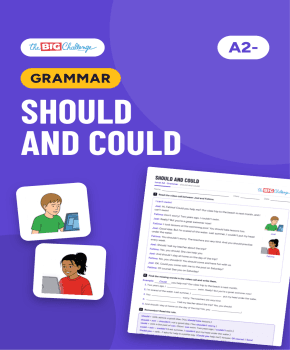
Advice with should and shouldn't, could and couldn't for the past, and polite requests with Could you, seen through a video call in which Joel, who can't swim, asks Fatima for help. Pupils find the missing words, read the rule, tick the right words, give advice, write about the past, give short answers, make polite requests and complete a letter to a problem page; answer key included.
Dokumenty do pobrania (2)
- Wersja kolorowa Na Twoim koncie nauczyciela
- Wersja czarno-biała Na Twoim koncie nauczyciela
Przewodnik dydaktyczny
Objective & content
This grammar sheet teaches should and could: advice with should and shouldn't (You should take lessons. You shouldn't worry.), Should I ...? with its short answers, could and couldn't as the past of can (Two years ago, I couldn't swim.) and polite requests with Could you ...?. Pupils read a video call in which Joel, who can't swim, asks Fatima for advice before a class trip to the beach; they find the missing words and read the rule, given in a box. By the end, they can give advice, say what they could and couldn't do in the past and ask for help politely.
Pedagogical guide
Page 1 is the video call, with a picture of Joel and of Fatima: Fatima couldn't swim two years ago, took lessons at the swimming pool, and tells Joel what he should and shouldn't do. Pupils find five missing words in sentences from the call. The rule, given in a box in short lines, follows; it includes "after should and could, the verb has no -s and no to". Page 2 has eight sentences where pupils tick the right word, five pieces of advice to write with should or shouldn't, four sentences about the past to write with could or couldn't, and four questions about Joel and Fatima to answer with short answers. Page 3 has four orders to turn into polite requests with Could you ...?, then a letter to a magazine's problem page: Saffron plays games on her phone every evening and can't stop, and Iris replies with her advice. Pupils circle the right word in eight brackets. Last, they give a friend who is always tired two pieces of advice. Every exercise opens with a worked example, except this free writing. Contracted and full forms are both right.
Suggested procedure
- (5 min) Say "I'm always tired. What should I do?" and write the pupils' advice on the board.
- (10 min) Read the video call aloud; pupils find the missing words.
- (5 min) Read the rule in the box with the class; pupils find examples of should and couldn't in the text.
- (10 min) Page 2: pupils tick the right words, then write the advice and the sentences about the past.
- (5 min) Page 2: short answers about Joel and Fatima.
- (10 min) Page 3: polite requests, the problem page, then the two pieces of advice.
- (5 min) Check with the answer key on page 4.
Adaptations
[S] Pupils read the video call aloud in pairs, one as Joel and one as Fatima, before the tasks.
[A] Pupils write a short letter to Iris about a problem of their own.
Materials & prerequisites
One copy of pages 1 to 3 per pupil. Pages 4 and 5 are the answer key and teacher notes: keep them. Pupils need can and can't, the present simple, the imperative and a few past simple forms (was, took, had), and the words for health, school and free time. To take it further, pupils swap letters and write a reply with three pieces of advice.
Możliwe adaptacje
- Słabsze poziomy: zaproponuj słuchanie partiami i dodatkowe materiały wizualne.
- Poziomy zaawansowane: zachęć do ustnego streszczenia i debaty po angielsku na ten temat.
- Liczne klasy: zorganizuj pracę w grupach ze zróżnicowanymi rolami.
🔒 Treść zastrzeżona
Ten zasób wymaga abonamentu, aby z niego skorzystać.
Odblokuj zasóbW cenie abonamentu