Wish and if only: The fake tan
Interaktywne ćwiczenia, aby utrwalić kompetencje Twoich uczniów.
Everything to teach I wish and If only: slides to project, a three-level practice sheet, a team game and a 10-minute quiz with answers. Grace wishes she wasn't so pale before the school photo, puts on half a bottle of fake tan without reading the instructions, and wakes up bright orange. Pupils learn wish + past simple and wish + could for wishes about now, wish + past perfect for regrets about the past, and If only with the same patterns. The game uses funny drawings: white trainers in festival mud, a cat asleep on a laptop. For B2, two lessons of about 45 minutes.
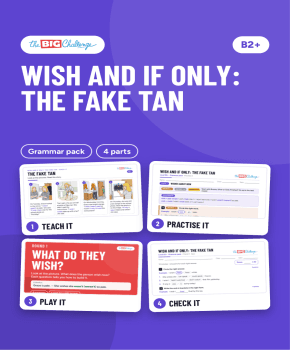
Dokumenty do pobrania (4)
- Teach it: lesson slides Na Twoim koncie nauczyciela
- Practise it: three-level sheet Na Twoim koncie nauczyciela
- Play it: team game Na Twoim koncie nauczyciela
- Check it: quiz and key Na Twoim koncie nauczyciela
Przewodnik dydaktyczny
Objective & content
Everything to teach I wish and If only, in one pack of four parts: slides to project, a three-level practice sheet, a team game and a 10-minute quiz with answers. The pack starts from a short story: Grace wishes she wasn't so pale before the school photo on Thursday, so she puts on half a bottle of fake tan and doesn't read the instructions. On Wednesday morning she is bright orange: "I wish I hadn't used so much! If only I'd read the instructions!" Now the photo is on the fridge, and she wishes it was in black and white. Pupils meet the patterns in the story before they meet the rule. The pack teaches wish + past simple and wish + could for wishes about now (I wish I had, I wish I was / were, I wish I could), wish + past perfect for regrets about the past (I wish I hadn't eaten it), and If only with the same patterns for stronger feelings. By the end, pupils can say what they would like to be different now and what they are sorry about in the past.
Pedagogical guide
The rule is given in Remember! boxes, not left to be deduced; the story and its pictures make the patterns easy to notice first. The practice sheet is one A4 sheet at three levels: every page has a Bronze, a Silver and a Gold task, so the whole class works on the same page and each pupil moves up when they finish. Page 1 is about wishes about now, page 2 about regrets about the past (its Gold task turns Grace's mistakes into her regrets), and page 3 mixes now and the past; its Gold task has pupils write their own If only sentences. The team game uses funny drawings: a short boy who can't see the band at a concert, a giant dog on the sofa, new white trainers in festival mud, a cat asleep on a laptop, a boy locked out on the doorstep. In the first round, teams write what each person wishes now, and every question says how to build the answer (wish + past simple, wish + could); in the third round, they write the regret with had or hadn't + past participle. Every round opens with a worked example. The quiz gives a mark out of 20. Was and were are both accepted after I wish. The pack does not teach wish + would for complaints (I wish you would stop) or mixed conditionals. The key page of the practice sheet holds the answers, teacher notes and common mistakes (for example "I wish I have a dog", "I wish I can swim" and "I wish I didn't eat so much yesterday"). Spelling is British English.
Suggested procedure
The pack fits two lessons of about 45 minutes. Lesson 1 is Teach it and Practise it; lesson 2 is Play it and Check it. The four parts can also be used alone.
- (25 min) Teach it (lesson.pdf, lesson 1): show the four pictures and ask "Why is Grace orange?", then read the story together. Read the Remember! boxes aloud; pupils say one true wish each (I wish I had ..., I wish I could ...), then turn what Grace did into her regrets and say them again with If only. Then do the six-question quick check with the class. The last slide is for the teacher and is not projected.
- (20 min) Practise it (practice.pdf, lesson 1): give each pupil the three pages and a start (Bronze, Silver or Gold); correct page by page, with one pupil from each medal reading an answer.
- (25 min) Play it (game.pdf, lesson 2): make teams and read each round's example together. Show each question, give 20 seconds to write the answer (40 seconds in round 3), then show the answer slide and keep the score. Round 4 is worth double points.
- (10 min) Check it (quiz.pdf, lesson 2): pupils work alone on page 1; mark out of 20 with page 2.
Adaptations
[S] Start every pupil at Bronze and keep the Remember! slides on screen during the practice and the game. Give them a card with two columns, "Now: wish + past simple / could" and "The past: wish + had / hadn't + past participle", and do the quiz in two halves.
[A] Send fast pupils straight to Gold and then to a short paragraph of their own: three wishes about their life now and three regrets about a day that went wrong, with at least two If only sentences.
Materials & prerequisites
A projector or screen for lesson.pdf and game.pdf (one PDF page per slide, turned with the arrow keys), and paper for the teams' answers. Print practice.pdf (3 pages for pupils; the key page is for the teacher) and quiz.pdf (page 1 for pupils, page 2 is the key), one copy per pupil. Pupils should already know the past simple, the past perfect and the second and third conditionals.
Możliwe adaptacje
- Słabsze poziomy: zaproponuj słuchanie partiami i dodatkowe materiały wizualne.
- Poziomy zaawansowane: zachęć do ustnego streszczenia i debaty po angielsku na ten temat.
- Liczne klasy: zorganizuj pracę w grupach ze zróżnicowanymi rolami.
🔒 Treść zastrzeżona
Ten zasób wymaga abonamentu, aby z niego skorzystać.
Odblokuj zasóbW cenie abonamentu