Shakespeare and the Shoemaker
Immersyjny audiobook, aby wzbogacić rozumienie ze słuchu Twoich uczniów.
Transport your students to the bustling London of Shakespeare with this captivating historical mystery! "Shakespeare and the Shoemaker" is an audio story that blends adventure, mystery, and culture. Students will follow Edmund, a clever young hero who uses his unique talent to solve an investigation. It is an excellent resource for working on aural comprehension of a suspenseful plot, while also discovering the world of the greatest English playwright.
Przewodnik dydaktyczny
Objective & Plot Summary
Objective: To lead students to follow an investigation in English, to identify suspects using aural clues, and to understand the resolution of a mystery.
Summary: In 16th-century London, a young shoemaker's apprentice with a photographic memory meets his hero, William Shakespeare. When the ending of Romeo and Juliet is destroyed in a suspicious fire, Edmund uses his cunning and talent to trap the culprit among three suspects and save the play.
Suggested Lesson Flow
1. Before Listening (~10 min): PLUNGING INTO 16TH-CENTURY LONDON
-
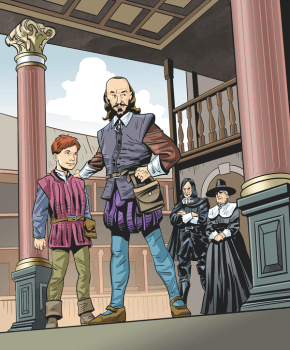
Anticipation: Show the illustration of the characters and the map (page 3). Who is Shakespeare? Where does the action take place?
-
Vocabulary: Introduce key investigation words:
fire,suspect,guilty,trap.
2. During Listening (~25 min): FOLLOWING THE TRAIL
-
Segmented listening in 3 parts:
-
Part 1 (The Suspects): Listen until the end of the visits by Greenaway, Benson, and Hardcastle. Pause: "Who is angry at Shakespeare? Why?".
-
Part 2 (The Crime): Listen until the discovery of the arson attack. Pause: "What happened? Who are the three suspects?".
-
Part 3 (The Resolution): Listen to Edmund's plan and the outcome.
-
3. After Listening (~15 min): SOLVING THE INVESTIGATION
-
Discussion: "Who was the guilty person? Why did he do it? Was Edmund's plan clever?".
-
Simple Task: Form 3 groups, one for each suspect. Each group prepares a sentence to claim their innocence or accuse another. Example: "I am Dame Hardcastle. I am not guilty. I think the actor did it!".
Adaptations
-
To Simplify: On the board, create a "Suspects" chart. After listening to the introduction of each suspect, pause and note down their name and the reason for their anger (the motive).
-
To Extend: Ask students to imagine they are Shakespeare. They write a short journal entry recounting the fire and their meeting with the "remarkable" Edmund.
Możliwe adaptacje
- Słabsze poziomy: zaproponuj słuchanie partiami i dodatkowe materiały wizualne.
- Poziomy zaawansowane: zachęć do ustnego streszczenia i debaty po angielsku na ten temat.
- Liczne klasy: zorganizuj pracę w grupach ze zróżnicowanymi rolami.
🔒 Treść zastrzeżona
Ten zasób wymaga abonamentu, aby z niego skorzystać.
Odblokuj zasóbW cenie abonamentu