Asking for Directions
A teaching resource designed to energise your English lessons.
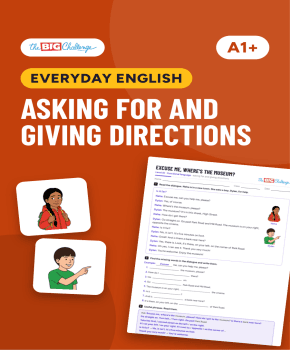
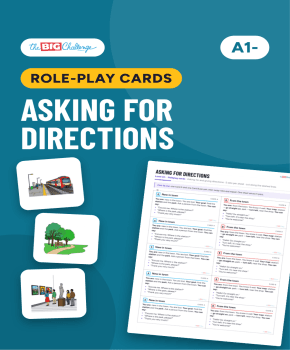
A1 pair roleplay: someone new in town asks a local for directions to the station and the park (ask, listen, follow). Two self-contained cut-out role cards (A/B), each with its own phrases, plus [S]/[A] variants. Prints 5 sets per A4.
Teaching guide
Objective & content
By the end, A1 students can ask for and follow simple directions to a place in town. This resource is a pair speaking activity: two self-contained cut-out role cards — someone new in town (Card A) and a local (Card B) — each carrying only the phrases that role needs, plus [S]/[A] variants. Prints 5 sets per A4 page.
Pedagogical guide
Roleplay cards work because each student only sees their own role: nobody can read ahead, so the exchange stays a real information gap. This card set follows asking-for-directions functional language (imperatives for giving directions, prepositions of place) and pairs naturally with a directions or town-vocabulary lesson. Use it as freer practice once students can recognise basic place names and simple imperative forms (go straight on, turn left).
Suggested procedure
- (2 min) Distribute one Card A and one Card B per pair; model one exchange with a confident student.
- (1 min) Set the goal: Card A finds the station and the park; swap and repeat afterwards.
- (8–10 min) Pairs run the exchange, then swap roles and repeat with the roles reversed.
- (2 min) Quick whole-class check: did students ask, listen, and follow directions correctly?
Adaptations
- [S] Give Card A a small map with the answers already marked; ask for one place only; no timer.
- [A] Cover the "You can say" lines and improvise; use the Card B complication (the station is closed — redirect to the bus stop); bonus: add a third place (the school).
Materials & prerequisites
Print the cards sheet (A4, 5 sets per sheet) and cut into cards; one set per pair. Assumes basic recognition of imperatives and common town-place vocabulary.
Curriculum alignment
Maps to Cycle 3 "child and close environment" (FR 6e) — describing one's surroundings and giving simple directions in a familiar setting.
Possible adaptations
- Lower levels: Offer segmented listening and additional visual aids.
- Advanced levels: Encourage an oral summary and a debate in English on the theme.
- Large groups: Organise group work with differentiated roles.