At the Restaurant
A teaching resource designed to energise your English lessons.
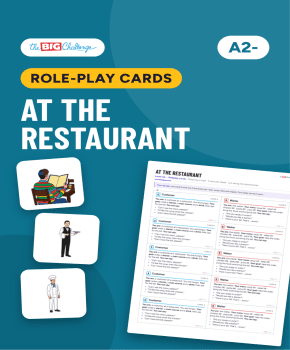
A2 pair roleplay: a customer orders a meal and asks for the bill; a waiter takes the order from a menu. Self-contained A/B cut-out cards with per-card phrases and [S]/[A] variants. Prints 5 sets per A4.
Documents to download (2)
- Roleplay cards In your teacher account
- Roleplay cards (black and white) In your teacher account
Teaching guide
Objective & content
By the end, A2 students can order a meal in a restaurant and ask for the bill. This resource is a pair speaking activity: two self-contained cut-out role cards — a customer (Card A) and a waiter (Card B) — each carrying only the phrases that role needs, plus [S]/[A] variants. Prints 5 sets per A4 page.
Pedagogical guide
Roleplay cards work because each student only sees their own role, so the exchange stays a real information gap. This card set targets ordering functional language (I'd like…, can I have…?) and pairs naturally with a food-and-drink lesson. Use it once students recognise basic meal vocabulary and can form simple requests.
Suggested procedure
- (2 min) Distribute one Card A and one Card B per pair; model one round with a confident student.
- (1 min) Set the goal: Card A orders a starter, main course and drink, then asks for the bill; Card B takes the order.
- (8–10 min) Pairs run the order, then swap roles and repeat.
- (2 min) Quick whole-class check: did students order and ask for the bill?
Adaptations
- [S] Give the customer a menu with a suggested order; order one course only.
- [A] Cover the "You can say" lines and improvise; use the complication (chicken is finished — offer pasta, adjust the total); bonus: swap roles and add a dessert.
Materials & prerequisites
Print the cards sheet (A4, 5 sets per sheet) and cut into cards; one set per pair. Assumes basic food/drink vocabulary and numbers.
Curriculum alignment
Maps to Cycle 3 "child and close environment" (FR 6e) — everyday transactions in a familiar setting.
Possible adaptations
- Lower levels: Offer segmented listening and additional visual aids.
- Advanced levels: Encourage an oral summary and a debate in English on the theme.
- Large groups: Organise group work with differentiated roles.
🔒 Restricted content
This resource requires a subscription to be viewed.
Unlock the resourceIncluded in the subscription