Play Ball!
Interactive exercises to consolidate your students’ learning.
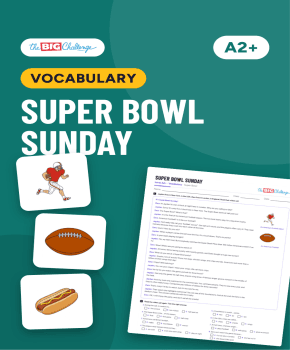
Baseball's Opening Day, through a video call between two friends: Carter is at the stadium in New York with his dad, with a hot dog and popcorn, sees a fan catch a home-run ball with his glove and sings "Take Me Out to the Ball Game" in the seventh inning, while Evie in London compares it with cricket, its flat bat, its bowler and its five-day games. Pupils answer questions on the call, name pictures, match words with their meanings, complete sentences, unscramble words and circle the right words in Carter's message after the game; answer key included. For A2 pupils, about 50 minutes in class.
Documents to download (2)
- Worksheet In your teacher account
- Worksheet (black and white) In your teacher account
Teaching guide
Objective & content
Carter in New York, in the USA, calls Evie in London, in England, from a baseball stadium. It is three o'clock in the afternoon in New York and evening in London, where Evie is already in her pyjamas. It is Opening Day, the first game of the baseball season, and there are thousands of fans. In the second inning, the best player of Carter's team hit a home run over the wall and into the crowd, and a man behind Carter caught the ball with his glove. Carter is wearing his team's cap and eating a hot dog, and in the seventh inning everybody stands up and sings "Take Me Out to the Ball Game", a song from 1908. Evie explains cricket: there is a bat, a ball and two teams too, but the bat is flat, the player with the ball is the bowler, a team has eleven players, and a big international game can last five days, with breaks for lunch and tea. Pictures of baseball and cricket sit beside the dialogue. Pupils answer multiple-choice questions, name pictures from a word box, match words with their meanings, complete sentences, unscramble words from the call, and end on Carter's message after the game, where they circle the right word in each bracket.
Pedagogical guide
Two sports that look alike let pupils compare the USA and England through words: a pitcher and a bowler, nine players and eleven, a game of about two and a half hours and a game of five days. The call mixes what is happening now (who's winning?, I'm wearing) with what happened earlier in the game (he hit a home run, a man caught it), so pupils read for facts in tenses they know, at a level they can read alone. A few words, such as home run, inning and pitcher, are new at this level: they name the game, and the tasks repeat them. The sentences take the words into other sports and everyday life, such as a tennis racket, the football season or a dog that catches a ball. Carter's message after the game reuses the words in a new text, with three choices each. Every task tests words, never grammar, and every item has one answer.
Suggested procedure
- (5 min) Ask pupils which sports people watch in a stadium in their country, and what fans eat and sing there.
- (10 min) Two pupils read the video call aloud; the class answers the questions.
- (10 min) Pupils name the pictures and match the words with their meanings.
- (10 min) Pupils complete the sentences, then unscramble the words.
- (10 min) Pupils read Carter's message and circle the right words.
- (5 min) Check with the answer key on page 3.
Adaptations
[S] Ask pupils which sports people watch in a stadium in their country, and what fans eat and sing there.
[A] Pupils act out the video call in pairs. To take it further, play the class "Take Me Out to the Ball Game" and let them sing the first two lines, or pupils tell a partner about a game they went to or watched on TV.
Materials & prerequisites
One copy of the two pupil pages per pupil, in colour or in black and white. Page 3 is the answer key with teacher notes: keep it. Pupils should be able to read short sentences in the past (he hit the ball, Dad bought popcorn) and tell the time (three o'clock).
Possible adaptations
- Lower levels: Offer segmented listening and additional visual aids.
- Advanced levels: Encourage an oral summary and a debate in English on the theme.
- Large groups: Organise group work with differentiated roles.
🔒 Restricted content
This resource requires a subscription to be viewed.
Unlock the resourceIncluded in the subscription