Canada
Interactive exercises to consolidate your students’ learning.
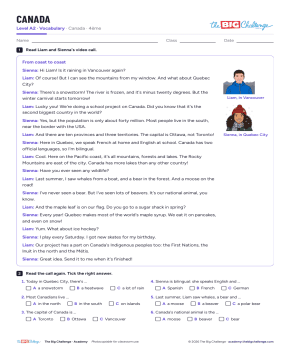
Canada from coast to coast, through a video call between two cousins, Liam in Vancouver and Sienna in Quebec City. Pupils answer questions, name Canadian animals, match meanings, complete sentences, find their way with north, south, east and west and finish with a crossword; answer key included.
Documents to download (2)
- Colour version In your teacher account
- Black and white version In your teacher account
Teaching guide
Objective & content
This sheet on Canada starts from a video call between two cousins at the two ends of the country: Liam lives in rainy Vancouver, on the Pacific coast, and Sienna lives in Quebec City, where a snowstorm has just hit and the winter carnival starts tomorrow. They talk about the size of Canada, its provinces and capital, its two official languages, its lakes, forests and wildlife, maple syrup, ice hockey and Canada's Indigenous peoples. Pupils learn to describe a country: its size, people, languages, landscapes and wildlife. They answer six multiple-choice questions, write six words such as moose, beaver and maple syrup under pictures, match eight words such as province, bilingual and wildlife with their meanings, complete eight sentences and write north, south, east or west in four sentences about Canada. The sheet ends with a ten-word crossword whose clues come from the call.
Pedagogical guide
The call carries the words of the topic, so pupils meet each one in context before working on it. Canada's Indigenous peoples are named with their own names (the First Nations, the Inuit and the Métis). In the picture task and in the sentences, two words in each box are extra, so pupils have to choose. Instead of a word-form task, a "finding your way" task puts the four compass points into sentences, with a worked example. The crossword has no word box: pupils find each word from its clue, which makes it the hardest task. Every task tests words, never grammar.
Suggested procedure
- (5 min) Show a map of Canada and ask the class to find Vancouver, Quebec City and Ottawa.
- (10 min) Two pupils read the call aloud; the class answers the six questions.
- (10 min) Pupils write the words under the six pictures, then match the eight words with their meanings.
- (10 min) Pupils complete the eight sentences, then write north, south, east or west in the four map sentences.
- (10 min) Pupils do the crossword, alone or in pairs.
- (5 min) Check with the answer key on page 4.
Adaptations
[S] Before reading, pupils say what they know about Canada and the class makes a word map on the board.
[A] Pupils present a province or a Canadian animal in four sentences. To take it further, the class compares Canada with France (size, languages, weather) on a short poster.
Materials & prerequisites
One copy of the three pupil pages per pupil, in colour or in black and white. Page 4 is the answer key: keep it. Pupils should know the past simple, the present perfect with ever, superlatives and there is / there are.
Possible adaptations
- Lower levels: Offer segmented listening and additional visual aids.
- Advanced levels: Encourage an oral summary and a debate in English on the theme.
- Large groups: Organise group work with differentiated roles.
🔒 Restricted content
This resource requires a subscription to be viewed.
Unlock the resourceIncluded in the subscription