Catch the train
A teaching resource designed to energise your English lessons.
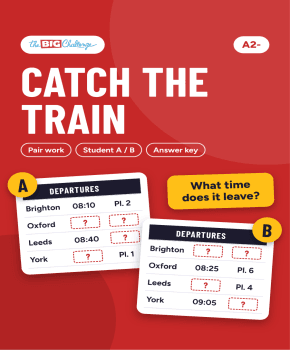
Pair work on a station departures board: half the class are Student A, half are Student B, and they ask each other questions to complete their page with the times, platforms and prices of eight trains. Practises What time does the train to ... leave?, Which platform ...? and How much is ...?, with 24-hour times and prices in pounds. 3 pages: Student A, Student B, teacher page with the answer key. About 15 to 20 minutes.
Documents to download (1)
- Colour version In your teacher account
Teaching guide
Objective & content
An information-gap pair activity built on a station departures board of eight trains. Half the class are Student A and half are Student B; each holds 12 of the 24 cells (time, platform and price of each train), and no cell is missing on both pages. Pupils ask each other to complete the board: "What time does the train to Oxford leave?", "Which platform does it leave from?", "How much is a ticket to Brighton?". By the end, pupils can ask for and give times, platforms and prices.
Pedagogical guide
Nobody can finish alone, so every pupil has to ask and to answer. The questions box on each page gives the three question frames and a model answer, and the first gap of each page is already filled in as a worked example. The language is present simple questions with does (What time does the train to ... leave?), Which platform ...? and How much is ...?, with times in the 24-hour clock (08:40, "eight forty") and prices in pounds (£34.50, "thirty-four pounds fifty"); a help line on the page shows how to say them. The set stays at A2- level. Page 3 is the teacher page: four steps, the full board as a key, and the answers to the last question.
Suggested procedure
One activity of about 15 to 20 minutes.
- (3 min) Set up the pairs: copy page 1 (Student A) for half the class and page 2 (Student B) for the other half, and put pupils in A + B pairs, face to face. Nobody shows their page.
- (4 min) Read the questions box with the class and model the worked example with one pupil.
- (10 min) Pairs ask and answer until the board is full. Walk round and listen for the times and prices.
- (3 min) Pairs swap pages to check, then answer the last question. Check with the key on page 3.
Adaptations
[S] Let pupils read the help line aloud first and allow them to read the answer from the questions box. Pupils may write the times as digits only and say them after their partner.
[A] Pupils plan a trip for their partner and say it in full sentences: "Take the 09:05 to York from platform 1. It costs £38.00."
Materials & prerequisites
Print infogap.pdf: page 1 for Student A and page 2 for Student B, one copy per pupil; page 3 is the teacher page. Pupils need a pencil. They should already know present simple questions with does, numbers up to 100 and how to tell the time. It goes well after a lesson on telling the time, and before work on travel and tickets.
Possible adaptations
- Lower levels: Offer segmented listening and additional visual aids.
- Advanced levels: Encourage an oral summary and a debate in English on the theme.
- Large groups: Organise group work with differentiated roles.
🔒 Restricted content
This resource requires a subscription to be viewed.
Unlock the resourceIncluded in the subscription