Who Ate the Christmas Pudding? (A2+)
Interactive exercises to consolidate your students’ learning.
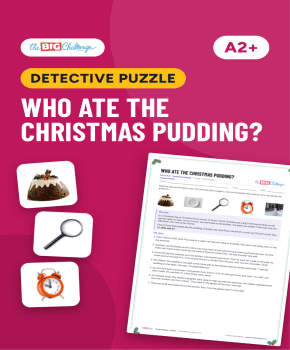
On Christmas Day, somebody ate Grandma's pudding: pupils use seven clues and a time grid to find out who, then explain why. A2+, in pairs, about 15 to 20 minutes, with the solved grid on the teacher page.
Documents to download (2)
- Puzzle sheet In your teacher account
- Puzzle sheet (black and white) In your teacher account
Teaching guide
Objective & content
A Christmas detective puzzle for pairs, about 15 to 20 minutes. On Christmas Day, between three and four o'clock, somebody ate Grandma Rose's Christmas pudding. Page 1 gives the case, five suspects and seven clues, written in the past simple with times ("until quarter past three", "at twenty past three"). Page 2 has a time grid, with the first suspect's line done as an example, and four questions. Pupils fill in the grid, cross out the people who could not do it, find the one who did and explain why in English. Page 3 is the teacher page.
Pedagogical guide
The puzzle makes pupils read for detail: each clue gives a place, a time or a witness, and only one person is left with nobody to say where they were. The grid turns the reading into a picture pupils can see and discuss. Question 2 is the language work: pupils write one sentence for each person who could not do it ("It wasn't ... because ...", "At ..., he was ...", "Nobody saw ..."). Question 4 is open. The teacher page shows the solved grid, the answers, and why there is only one possible answer.
Suggested procedure
- (3 min) Read the case together. Look at the time grid and the example line.
- (10 min) Pairs read the clues and fill in the grid.
- (5 min) Pairs answer the four questions. Then a few pairs say who did it and why; the class agrees or not.
Adaptations
[S] Read the clues aloud with the class first, and fill in a second line of the grid together.
[A] Pairs present their solution to the class without notes, one clue at a time.
Materials & prerequisites
One copy of pages 1 and 2 per pair (or per pupil), in colour or in black and white; keep page 3 for yourself. Pupils need the past simple and the time (quarter past, half past, twenty past).
Possible adaptations
- Lower levels: Offer segmented listening and additional visual aids.
- Advanced levels: Encourage an oral summary and a debate in English on the theme.
- Large groups: Organise group work with differentiated roles.
🔒 Restricted content
This resource requires a subscription to be viewed.
Unlock the resourceIncluded in the subscription