Civil rights
Interactive exercises to consolidate your students’ learning.
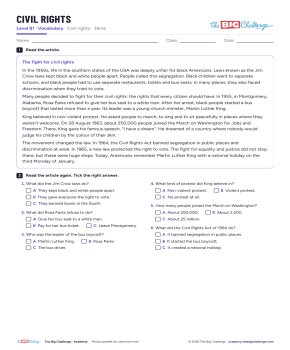
The civil rights movement in the USA: an article on the Jim Crow laws, the Montgomery bus boycott, Martin Luther King's "I have a dream" speech and the laws of 1964 and 1965. Pupils work through the words of unfair laws, peaceful protest and change, from meanings and word forms to collocations, and end on Ruby Bridges's story with three-way choices; answer key included.
Documents to download (2)
- Colour version In your teacher account
- Black and white version In your teacher account
Teaching guide
Objective & content
This sheet on civil rights opens on an article, "The fight for civil rights". In the 1950s, the Jim Crow laws kept black and white people apart in the southern states of the USA; the article tells how Rosa Parks refused to give up her bus seat in Montgomery, how Martin Luther King led a peaceful movement and gave his "I have a dream" speech, and how the laws of 1964 and 1965 banned segregation and protected the right to vote. It carries all the target words in context, from unfair, segregation and discrimination to boycott, non-violent, equality and justice. By the end, pupils understand and use the words to talk about the civil rights movement: unfair laws, peaceful protest and the changes it won.
Pedagogical guide
The vocabulary work comes out of the article, never from a list. Page 1 checks understanding with six multiple-choice questions. Page 2 matches eight words with their meanings (segregation, a citizen, a boycott, to ban) and uses ten words from a box of twelve in new sentences; two words are extra. Page 3 turns adjectives into nouns with -ity (equal, equality), with a worked example and five items, matches six collocations (fight for your rights, give a speech, face discrimination) and ends on the story of Ruby Bridges, who was six when she became the first black child at an all-white primary school in New Orleans in 1960. Each of its eight gaps is a choice between three topic words. It is the hardest task: the wrong words come from the same topic (segregation, movement or boycott). Every task tests words, never grammar. Keep the talk on facts and courage.
Suggested procedure
- (5 min) Show the southern states of the USA on a map; ask pupils what they know about Rosa Parks or Martin Luther King.
- (10 min) Pupils read the article and answer the six questions.
- (15 min) Page 2: match the meanings, then complete the ten sentences.
- (15 min) Page 3: adjectives into nouns, the collocations, then Ruby Bridges's story.
- (10 min) Correct with the answer key on page 4; pupils read Ruby Bridges's story aloud with the right words.
Adaptations
[S] Read the article aloud together first; show the southern states of the USA on a map.
[A] After the collocations, pupils write three sentences about a right they think is important today.
Materials & prerequisites
One copy per pupil of the three pupil pages, in colour or black and white. Page 4 is the answer key with teacher notes: keep it. Pupils should know the past simple, relative clauses with where and that, have to and the modals can, should and would. The sheet has no writing task; to take it further, pupils listen to part of the "I have a dream" speech and note the words they recognise, or present another person from the movement in one minute.
Possible adaptations
- Lower levels: Offer segmented listening and additional visual aids.
- Advanced levels: Encourage an oral summary and a debate in English on the theme.
- Large groups: Organise group work with differentiated roles.
🔒 Restricted content
This resource requires a subscription to be viewed.
Unlock the resourceIncluded in the subscription