Adjectives of Taste- 2 - A2 Synonyms
Interactive exercises to consolidate your students’ learning.
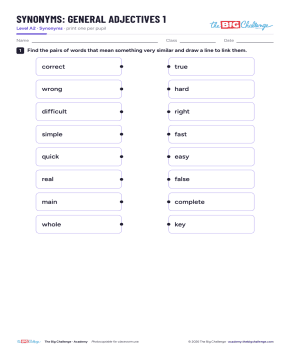
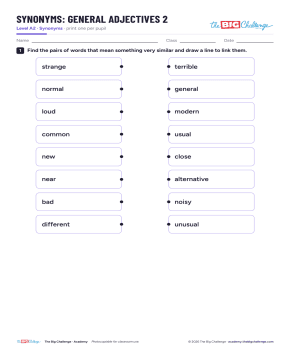
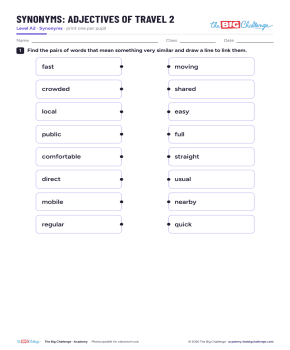
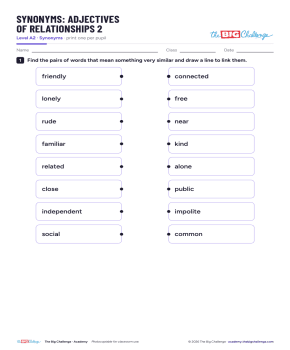
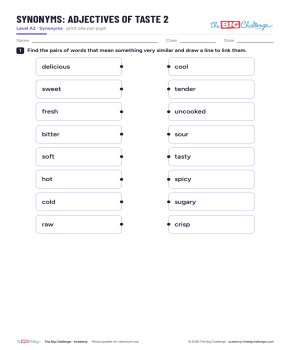
A printable A2 pairing worksheet on adjectives of taste: 8 words in each of two columns, to be joined to the word that means almost the same. Recognition practice that works both on the day the words are introduced and as later revision, in about 25 minutes.
Documents to download (2)
- Colour version In your teacher account
- Black and white version In your teacher account
Teaching guide
Objective & Principle of the Activity
The objective is to introduce and consolidate the **basic vocabulary** used to describe food (taste, texture, temperature) for **A2 level students**.
The activity consists of a **synonym matching exercise**. Students must connect pairs of adjectives with similar meanings. The vocabulary covers flavors, textures or states, and temperature or spice sensations. This activity allows students to acquire concrete and useful words for everyday situations.
Suggested Lesson Flow
Before the Activity (~5 min): I Like / I Don't Like
Show images of foods with strong flavors (lemon, cake, chili pepper, etc.). For each image, ask students "Do you like it?" then "Is it sweet? Is it sour?". Write the key adjectives on the board.
During the Activity (~5-10 min): Gourmet Matching Game
Distribute the activity sheet. Complete the first pair as a whole group to ensure the instructions are understood. Let students, alone or in pairs, connect the other pairs. Lead a group correction, using **mimes** to reinforce the meaning (shivering for "cold," fanning their mouth for "hot/spicy").
After the Activity (~10 min): Guess What I'm Eating!
The teacher (or a volunteer student) thinks of a food and describes it using 2 or 3 of the studied adjectives. For example: "It's **cold** and **sweet**." The other students must guess what food it is ("**Ice cream!**").
Adaptations
-
To Simplify: Use **real food** or play food for a sensory experience that anchors the vocabulary. Do the entire activity as a highly guided large group activity.
-
To Extend: Ask students to create a simple menu for their "**dream restaurant**," describing each dish with one or two of the adjectives learned.
Possible adaptations
- Lower levels: Offer segmented listening and additional visual aids.
- Advanced levels: Encourage an oral summary and a debate in English on the theme.
- Large groups: Organise group work with differentiated roles.
🔒 Restricted content
This resource requires a subscription to be viewed.