Odd One Out - A2 Transportation
Interactive exercises to consolidate your students’ learning.
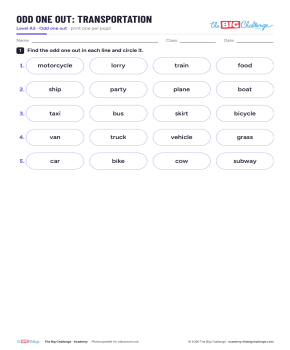
A2 vocabulary worksheet (transportation): 5 lines of four words where students find and circle the odd one out, with an answer key.
Documents to download (2)
- Colour version In your teacher account
- Black and white version In your teacher account
Teaching guide
Objective & Exercise Summary
The main pedagogical objective is to reinforce the recognition and memorization of A2 level vocabulary related to means of transport (train, plane, lorry, subway, etc.) by developing the ability to categorize and identify a word that does not belong to this lexical field. The resource is an "Odd One Out" type exercise composed of nine lines. In each line, the majority of words refer to a vehicle or a means of locomotion, while the odd one out is an A1 common noun from another semantic field (e.g.: food, party, skirt, cow, grass). The student must circle the word extraneous to the transport theme.
Suggested Procedure
Before the activity (~5 min): CLASSIFY MEANS OF MOBILITY
-
Getting started: The teacher distributes the worksheet. Write 'Transportation' on the board. Ask students to classify the means of transport they know into three categories: 'By land', 'By sea', 'By air'.
-
Concept review: Remind students of the 'Odd One Out' rule: in each line, which word **cannot** take us somewhere?
During the activity (~15-20 min): ANALYZE AND CATEGORIZE BY TYPE
-
Step 1: Individual and discreet resolution (10 min). Students read and circle the odd one out. Encourage students to identify whether the word is a vehicle, a person, or a thing to quickly determine the odd one out.
-
Step 2: Peer verification and justification (5-10 min). In pairs, students compare their choices. They prepare oral justification using the complete sentence: « Food is the odd one out because **motorcycle, lorry, and train** are **transport** (or **vehicles**). »
After the activity (~10-15 min): DESCRIBE A TRIP
-
Collective correction: Proceed with oral correction. Ask students to note the generic word vehicle and types of vehicles (lorry, truck) as a way to enrich their A2 lexicon.
-
Written/oral production: Ask students to choose two or three means of transport from the list and create a sentence about an ideal or real trip (e.g.: « I go to the mountains **by train** and I come back **by car** ») using the preposition 'by'.
Adaptations
-
To simplify: First, propose a matching exercise for more difficult A2 words (e.g.: lorry, van, subway) with images to ensure comprehension before the discrimination exercise.
-
To deepen: Introduce specific action verbs (A2): ask students to link each transport to its verb (e.g.: We **sail** a boat/ship, We **ride** a bicycle/motorcycle, We **drive** a car) to enrich production.
Possible adaptations
- Lower levels: Offer segmented listening and additional visual aids.
- Advanced levels: Encourage an oral summary and a debate in English on the theme.
- Large groups: Organise group work with differentiated roles.
🔒 Restricted content
This resource requires a subscription to be viewed.