Vocabulary - Set 14 - A1 Word Scramble
Vocabulary
Interactive exercises to consolidate your students’ learning.
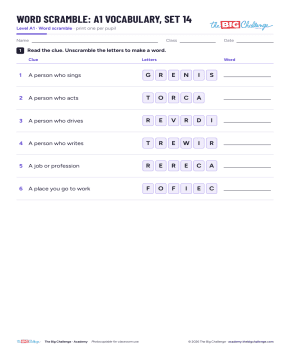
A printable A1 word-scramble sheet on jobs and work: students rebuild 6 words from their jumbled letters, guided by a one-line hint. Spelling and recall practice for vocabulary already taught, ready to print and run in about 20 minutes.
Documents to download (2)
- Colour version In your teacher account
- Black and white version In your teacher account
Teaching guide
Objective & Plot Summary
The pedagogical objective is to consolidate the recognition and spelling of the main time markers (past/future days, units of measurement) at A1 level. The resource is a word scramble exercise offering six words to decipher. Each scrambled word (e.g., DATSYEREY, MORROTOW, RUOH) is associated with a hint that defines it temporally (e.g., "The day before today", "The day after today", "60 minutes"). Students must use their knowledge to identify the words **YESTERDAY**, **TOMORROW**, **HOUR**, **MINUTE**, **WEEK**, and **AFTERNOON**, then reconstruct them with correct spelling from the jumbled letters.
Suggested Procedure
Before the activity (~5 min): CALENDAR AND CLOCK
-
Orally review vocabulary: ask students "What day is today?", "What day was YESTERDAY?", "What day is TOMORROW?" to orient them in time.
-
Emphasize predictable spelling difficulties, especially long words like **TOMORROW** and **YESTERDAY**, to encourage caution during deciphering.
During the activity (~15-20 min): DECODING THE CHRONOLOGY
-
Step 1: Students work individually on the six words. They focus on word structure, particularly the presence of double letters in **TOMORROW** or the structure of **AFTERNOON**.
-
Step 2: After 10 minutes, conduct a partial correction of the first two words (YESTERDAY, TOMORROW). Ask a student to spell them on the board to help those struggling with long spellings.
-
Step 3: Finalize the correction of the other four words (HOUR, MINUTE, WEEK, AFTERNOON). Emphasize the pronunciation of the silent 'h' in **HOUR** and the link between "week" and "seven days".
After the activity (~5-10 min): PLANNING THE ACTION
-
**Personal Planning:** Ask students to write three simple (A1) sentences using **YESTERDAY**, **TODAY**, and **TOMORROW** to talk about their activities (Ex: "I watched TV YESTERDAY." "I will play football TOMORROW.").
-
**Definition Game:** In pairs, ask students to create a new *Word Scramble* challenge using the discovered words and writing their own hints (e.g., "The time between lunch and dinner" $ ightarrow$ AFTERNOON).
Adaptations
-
To simplify: Provide the exact number of letters for each word to decipher, thus facilitating the reorganization of letters.
-
To extend: Introduce associated prepositions of time: *on* for **WEEK**, *in the* for **AFTERNOON**, *at* for **HOUR** and **MINUTE**. Ask for complex sentences using these prepositions.
Possible adaptations
- Lower levels: Offer segmented listening and additional visual aids.
- Advanced levels: Encourage an oral summary and a debate in English on the theme.
- Large groups: Organise group work with differentiated roles.
🔒 Restricted content
This resource requires a subscription to be viewed.