One bag each
Interactive exercises to consolidate your students’ learning.
A revision of countable and uncountable nouns for older learners: a / an, some, much and many, how much and how many, too much and too many, a lot of; then the nouns that are never counted in English (advice, information, luggage, news, homework, furniture, money, luck, work, weather), with no a / an, no -s and a singular verb, a piece of and a bit of to count them, and as much ... as, as many ... as and not as ... as. Pupils read a dialogue between two friends who pack for a school trip, find the missing words, read the rule, tick the sentence that means the same, tick the right form, say sentences again, circle the right words in a message and write three sentences comparing themselves with somebody; answer key included.
Documents to download (2)
- Colour version In your teacher account
- Black and white version In your teacher account
Teaching guide
Objective & content
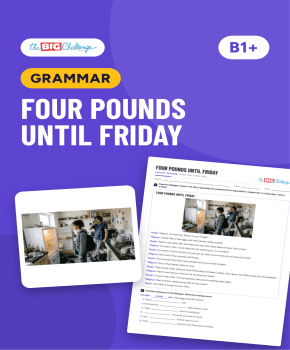
This grammar sheet is a revision sheet for older learners. It goes back over countable and uncountable nouns (a / an, some, much and many, how much and how many, too much and too many, a lot of for both), then works on the nouns that are never counted in English though they are in French or German: advice, information, luggage, news, homework, furniture, money, luck, work and weather, with no a / an, no -s and a singular verb (The news is bad), a piece of and a bit of to count them (a piece of advice), and as much ... as, as many ... as and not as ... as (I haven't got as much money as last year). Pupils read a dialogue between Jake and Fabian on the Sunday evening before a week in the mountains with their class (the teacher's letter says one bag each, and Jake has three), find the missing words and read the rule, set out in a chart. By the end, they say some advice and How much money?, use is after news, and stop writing informations and as much bags as.
Pedagogical guide
The sheet works on one question (can you count the noun?) and on the verb and the words that come with it. Page 1 is the dialogue, with a photo of the scene and six sentences to complete. Page 2 opens with the rule chart (six rows: the words, when to use them, an example), then works on meaning (exercise 4: five sentences, more, less or the same, tick the one of two sentences that means the same) and on form (exercise 5: six items, three options each, where the noun decides). Page 3 opens with the chart of five usual mistakes (an advice, two advices, The informations are here, The news are good, How many money?, as much bags as you). Pupils then say four sentences again with the first words given (exercise 7), circle the right words in Jake's message to his mum (exercise 8: eight brackets, the first one done as an example) and write three sentences that compare them with a friend or someone in their family (exercise 9). Exercises 2, 4, 5 and 7 open with a worked example.
Suggested procedure
- (5 min) Write How ... bags have you got? How ... luggage have you got? on the board. Ask pupils which word goes in each gap and why; collect ideas and keep the sentences for step 3.
- (10 min) Read the dialogue aloud; pupils find the missing words in the six sentences (exercise 2).
- (5 min) Read the rule chart with the class. Come back to the board and complete the sentences with many and much. Pupils say which other nouns on the chart take much.
- (15 min) Page 2: exercises 4 and 5.
- (15 min) Page 3: the chart of mistakes, then exercises 7 and 8.
- (5 min) Check exercises 2, 4, 5, 7 and 8 with the answer key on page 4. Pupils can do exercise 9 at home.
Adaptations
[S] Pupils read the dialogue aloud in pairs before they look for the missing words.
[A] In pairs, pupils list what they would pack for a week away and tell the class four things with too much, too many, as much ... as and as many ... as.
Materials & prerequisites
One copy of pages 1 to 3 per pupil, in colour or in black and white. Page 4 is the answer key and teacher notes: keep it. Pupils need the present simple and continuous, the past simple, the present perfect, have got and will, the words much, many and some, and a few words for a trip (luggage, bag, pack, jumper, weather).
Curriculum alignment
French lycée programme (2025), grammar list at A2+: "quantifiers much, many, some, any, no"; the same programme lists "Comparatives with countable and uncountable nouns (as many... as)" among its B2 items. The sheet revises the first at B1 and brings in the second in its simplest form (as much ... as, as many ... as, not as ... as), with the uncountable nouns French and German speakers still count.
Possible adaptations
- Lower levels: Offer segmented listening and additional visual aids.
- Advanced levels: Encourage an oral summary and a debate in English on the theme.
- Large groups: Organise group work with differentiated roles.
🔒 Restricted content
This resource requires a subscription to be viewed.
Unlock the resourceIncluded in the subscription