Crime and detectives
Interactive exercises to consolidate your students’ learning.
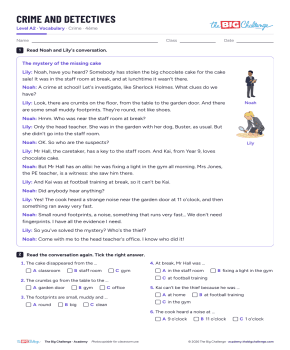
Crime and detective stories, through Noah and Lily, two pupils who investigate a chocolate cake missing from the staff room. Pupils answer questions, label pictures, match words with their meanings, complete sentences and find the thief in a mystery word; answer key included.
Documents to download (2)
- Colour version In your teacher account
- Black and white version In your teacher account
Teaching guide
Objective & content
This sheet on crime and detective stories starts from a light school mystery: the big chocolate cake for the cake sale has disappeared from the staff room, and Noah and Lily investigate like Sherlock Holmes. They look at the clues, the suspects and their alibis, and the conversation stops on "I know who did it!". Pupils answer six multiple-choice questions, label six pictures from a box of eight words, match ten words such as clue, witness and alibi with their meanings and complete eight sentences with words such as guilty and innocent. The last and hardest task is a mystery word: pupils write six words from clues, and the shaded letters spell the name of the thief.
Pedagogical guide
The conversation carries the words of the topic, so pupils meet each one before working on it, and it works like a real detective story: every clue pupils need is in the text. It also models can't for a deduction (it can't be Kai). There is no real crime and no violence. The tasks go from recognising words to using them: pictures, meanings, new sentences, then the mystery word. Before the last task, ask the class to guess the thief from the clues in the text; the mystery word gives the answer. Every task tests words, never grammar.
Suggested procedure
- (5 min) Ask which detectives pupils know and write crime words they know on the board.
- (10 min) Two pupils read the conversation aloud, one per detective; the class answers the six questions.
- (10 min) Pupils label the pictures, then match the words with their meanings.
- (8 min) Pupils complete the sentences; remind them that two words are extra.
- (5 min) The class guesses the thief from the clues in the text.
- (10 min) Pupils solve the mystery word; check with the answer key on page 4.
Adaptations
[S] Pupils read the conversation aloud in pairs, one pupil per detective, before they work alone.
[A] Pupils write the last part of the story: how Noah and Lily prove who did it. To take it further, groups invent a classroom mystery with three suspects and swap it with another group.
Materials & prerequisites
One copy of the three pupil pages per pupil, in colour or in black and white. Page 4 is the answer key: keep it. Pupils should know the past simple and the past continuous (he was fixing a light).
Possible adaptations
- Lower levels: Offer segmented listening and additional visual aids.
- Advanced levels: Encourage an oral summary and a debate in English on the theme.
- Large groups: Organise group work with differentiated roles.
🔒 Restricted content
This resource requires a subscription to be viewed.
Unlock the resourceIncluded in the subscription