Reading B1+: How Clever Are Crows?
Interactive exercises to consolidate your students’ learning.
A B1+ reading about crows: a crow that bent a wire into a hook, crows that solved an old story's puzzle, and crows that remember human faces. One text with a word box, ten questions and a group speaking task, clever, cleverer, cleverest, plus an answer key; 30 to 40 minutes.
Documents to download (2)
- Reading comprehension In your teacher account
- Reading comprehension (black and white) In your teacher account
Teaching guide
Objective & content
A B1+ reading that turns the insult "bird brain" upside down. The text presents three experiments. At the University of Oxford, a crow called Betty bent a straight wire into a hook to pull food out of a tube, although she had never used wire before. Wild crows solved the puzzle of an old story: they dropped stones into a tube of water to bring floating food up, as well as children aged five to seven. At the University of Washington, crows caught by scientists in a caveman mask shouted at anyone wearing it, and five years later even young crows did it. By the end, pupils can follow a short popular-science text, explain what an experiment shows, and compare skills with superlatives. It is part of the Reading B1+ set: one-text readings with the same layout.
Pedagogical guide
The sheet has one text of about 330 words at B1+, with no sentence longer than 20 words, and a word box with six words explained in English (wire, hook, bend, jug, float, mask). The ten questions go from finding information to explaining it: three choices or true or false first, then "How did the crows show that they remembered the caveman mask?" and "Which of the three experiments surprised you most? Why?" The text models the passive (some food was put in a small bucket), the past perfect (the crows had never used wire before; young crows that had never been caught) and the superlative (among the cleverest animals on Earth). The speaking task puts the superlative to work: pupils rank the crows' three skills. Every fact comes from published research on crows.
Suggested procedure
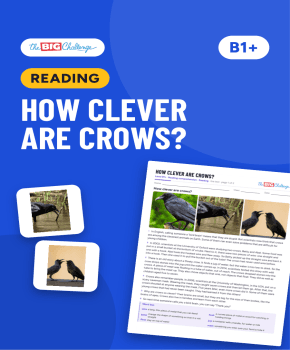
- (5 min) Warm-up: show the three photos and ask "Are crows clever? What can they do?"
- (10 min) Pupils read the text alone. They can use the word box.
- (10 min) Pupils answer questions 1 to 10, then check in pairs. Correct together with the key; for 9 and 10, take two or three answers.
- (10 to 15 min) Speaking task: in groups, pupils put the crows' three skills in order, from the most to the least impressive, then think of another clever animal and tell the class.
Adaptations
[S] Go through the word box first, with the photos. Before question 9, read paragraph 4 again together. Pupils can answer questions 1 to 8 only, and give their top skill in the speaking task.
[A] Pupils find out about another clever animal (an octopus, a dolphin, a parrot) and present one experiment to the class, with one passive and one superlative.
Materials & prerequisites
The sheet in colour or low ink (the low-ink version has no pictures), one copy per pupil: pages 1 and 2 are for pupils, page 3 is the answer key. A screen to show the photos for the warm-up. Pupils should know the past simple and have met the passive and the past perfect.
Possible adaptations
- Lower levels: Offer segmented listening and additional visual aids.
- Advanced levels: Encourage an oral summary and a debate in English on the theme.
- Large groups: Organise group work with differentiated roles.
🔒 Restricted content
This resource requires a subscription to be viewed.
Unlock the resourceIncluded in the subscription