Reading B1+: Why Do Songs Get Stuck in Your Head?
Interactive exercises to consolidate your students’ learning.
A B1+ reading about earworms, the songs that get stuck in your head: which songs stick, and what scientists found to get rid of them (chewing gum, an easy puzzle). One text with a word box, ten questions and a pair speaking task, plus an answer key; 30 to 40 minutes.
Documents to download (2)
- Reading comprehension In your teacher account
- Reading comprehension (black and white) In your teacher account
Teaching guide
Objective & content
A B1+ reading about something every pupil knows: a song that won't leave your head. The text opens with a song heard on the way to school that is still playing during a maths test, then explains what scientists call an earworm. A team at Goldsmiths, University of London, found that about nine out of ten people get one at least once a week, and that the songs that stick are usually quite fast, with a simple tune and one surprising jump between notes. The text then looks at what helps: in a study at the University of Reading, chewing gum cut the earworm by about a third, and an easy puzzle helps too, although a hard one makes it worse. It ends with a smile: if nothing works, choose a song you like! By the end, pupils can follow a short popular-science text, find details, tell a proven idea from an untested one, and talk about their own earworms. It is part of the Reading B1+ set: six one-text readings with the same layout.
Pedagogical guide
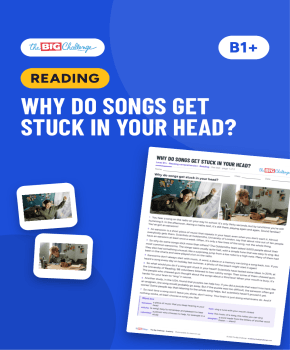
The sheet has one text of about 360 words at B1+, with no sentence longer than 20 words, and a word box with six words explained in English (earworm, hum, catchy, tune, volunteer, anagram). The ten questions go from finding information to explaining it: three choices or true or false first, then "How many volunteers took part in the study in Reading, and what did they do first?" and "Why do you think fast songs with a simple tune get stuck in our heads?" The text runs on the second conditional ("If you did a puzzle that wasn't too hard, the song would probably go away"), with a little past perfect and the B1+ linkers, so it works well after a lesson on the second conditional. The speaking task uses the same structure: "If a song got stuck in my head, I would ..." Every fact comes from published research, and the text says clearly that one popular cure (listening to the whole song) has not been proved.
Suggested procedure
- (5 min) Warm-up: show the two photos and ask "Has a song ever got stuck in your head? Which one?"
- (10 min) Pupils read the text alone. They can use the word box.
- (10 min) Pupils answer questions 1 to 10, then check in pairs. Correct together with the key; for 9 and 10, take two or three answers.
- (10 to 15 min) Speaking task: in pairs, pupils talk about a song that gets stuck in their head, where they heard it and what they would do to get rid of it, with the sentence starters. A few pairs tell the class.
Adaptations
[S] Go through the word box first and hum a well-known tune to show "hum" and "catchy". Pupils can answer questions 1 to 8 only, and use one sentence starter in the speaking task.
[A] Pupils find the second conditional sentences in the text and write three of their own about music ("If I could meet any singer, I would ..."). They can also design a small class survey: how many of us had an earworm this week?
Materials & prerequisites
The sheet in colour or low ink (the low-ink version has no pictures), one copy per pupil: pages 1 and 2 are for pupils, page 3 is the answer key. A screen to show the photos for the warm-up. Pupils should know the past simple and have met the second conditional.
Possible adaptations
- Lower levels: Offer segmented listening and additional visual aids.
- Advanced levels: Encourage an oral summary and a debate in English on the theme.
- Large groups: Organise group work with differentiated roles.
🔒 Restricted content
This resource requires a subscription to be viewed.
Unlock the resourceIncluded in the subscription