The environment
Interactive exercises to consolidate your students’ learning.
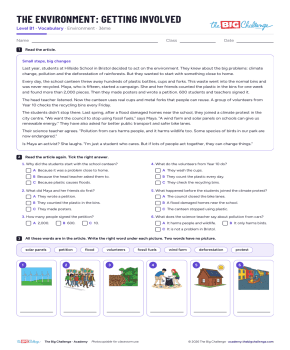
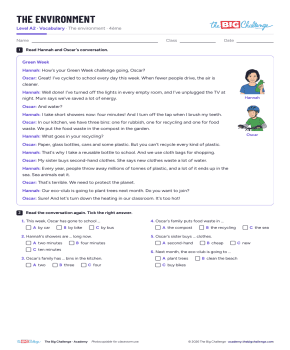
Green habits at home and at school, through two friends comparing their Green Week challenge: cycling to school, saving energy and water, recycling and less plastic. Pupils answer questions, name green objects, match meanings, complete sentences, make adjectives with -able and finish with a mystery word; answer key included.
Documents to download (2)
- Colour version In your teacher account
- Black and white version In your teacher account
Teaching guide
Objective & content
This sheet on the environment stays with green habits at home and at school. It starts from a conversation between two friends comparing their Green Week challenge: Oscar has cycled to school every day, Hannah has turned off the lights and takes four-minute showers, and they talk about the three bins in Oscar's kitchen, reusable bottles, second-hand clothes, plastic in the sea and their school eco-club. Pupils learn to say what they do, and could do, for the planet. They answer six multiple-choice questions, write six words such as bin, tap and compost under pictures, match eight words such as recycle, reuse and rubbish with their meanings and complete eight sentences with phrasal verbs and other words from a box. They then make five adjectives with -able, after a worked example. The sheet ends with a mystery word: seven clues from the conversation reveal a hidden word.
Pedagogical guide
The conversation carries the words of the topic, so pupils meet each one in context before working on it. The tone is hopeful and practical: every word is something a pupil can do this week. Campaigns, protests and endangered wildlife belong to the B1 environment sheet, so none of them is a target word here. The phrasal verbs (turn off, turn down, throw away, end up) appear in the text first, then whole in the box. The picture task and the sentences each have two extra words in the box, so pupils cannot finish by elimination. The word-form task has one pattern only, adjectives with -able; pupils must watch the spelling (reusable, recyclable). In the mystery word, the clues point back to the conversation. Every task tests words, never grammar.
Suggested procedure
- (5 min) Ask "How do you come to school? What do you recycle at home?" and write the answers on the board.
- (10 min) Two pupils read the conversation aloud; the class answers the six questions.
- (10 min) Pupils write the words under the pictures, then match the eight words with their meanings.
- (10 min) Pupils complete the eight sentences, then make the five adjectives with -able.
- (10 min) Pupils solve the mystery word, rereading the conversation when they need to.
- (5 min) Check with the answer key on page 4.
Adaptations
[S] Pupils list on the board the green things they already do at home before reading.
[A] Pupils plan a Green Week challenge for the class: five actions, one for each day. To take it further, the class runs the challenge and reports the results in English.
Materials & prerequisites
One copy of the three pupil pages per pupil, in colour or in black and white. Page 4 is the answer key: keep it. Pupils should know the past simple, the present perfect with already, and going to for plans.
Possible adaptations
- Lower levels: Offer segmented listening and additional visual aids.
- Advanced levels: Encourage an oral summary and a debate in English on the theme.
- Large groups: Organise group work with differentiated roles.
🔒 Restricted content
This resource requires a subscription to be viewed.
Unlock the resourceIncluded in the subscription