Feelings
Interactive exercises to consolidate your students’ learning.
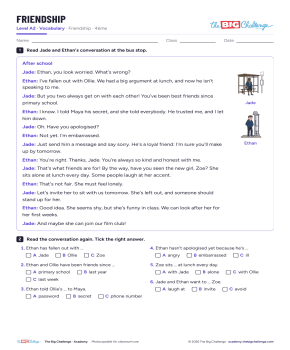
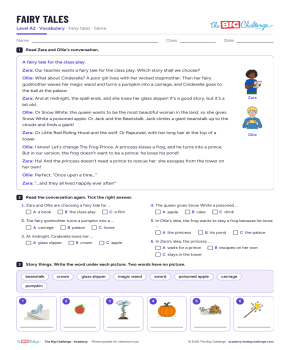
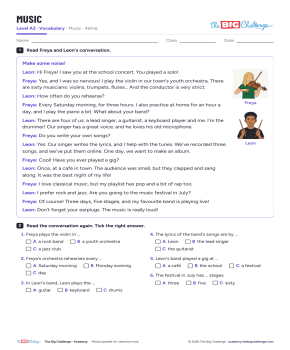
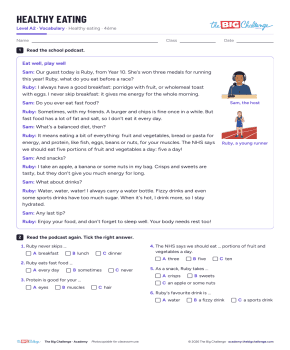
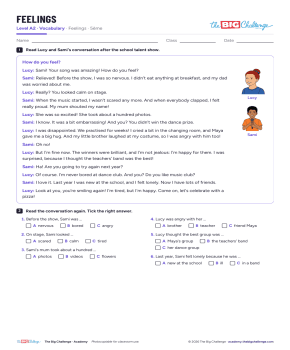
Lucy and Sami talk after the school talent show: nerves before the song, pride, a lost dance prize and a lonely first year that ended well. Pupils answer questions, name feelings from faces, match meanings, complete sentences, turn -ed adjectives into -ing ones and find sixteen words in a word search with a hidden message; answer key included.
Documents to download (2)
- Colour version In your teacher account
- Black and white version In your teacher account
Teaching guide
Objective & content
This sheet on feelings starts from a conversation between two friends after the school talent show: Sami was nervous before his song and proud at the end, and Lucy was disappointed when her dance group did not win. They also remember Sami's first year at the school, when he felt lonely. The conversation carries the target words, from nervous, relieved and proud to jealous, lonely and embarrassing. Pupils learn to say how they feel and why ("I was nervous because...", "I felt proud when..."). They answer six multiple-choice questions, name six feelings from faces with a box of eight words, match eight words with their meanings, complete seven sentences with verbs such as cry, clap and hug, and turn five -ed adjectives into -ing ones. The sheet ends on a word search: sixteen words from the conversation, and the letters left over spell a hidden message.
Pedagogical guide
Pupils meet every word in the conversation before they practise it, then move from recognising the words to using them. The feelings stay everyday and light: nerves, pride, a lost prize, a first lonely year that ends well. Every task tests words only: no answer depends on a tense. In the picture task and the gap-fill, two words in each box are extra, so pupils cannot finish by elimination. The word-form task asks for one kind of change, from the -ed feeling to the -ing cause, and opens with a worked example (embarrassed, embarrassing). The word search is the hardest task: the words go across, down and diagonally, and the hidden message ("It is OK to feel sad sometimes") rewards pupils who find them all.
Suggested procedure
- (5 min) Show a face (yours or a picture); the class names the feeling. Write the words on the board.
- (10 min) Two pupils read the conversation aloud; the class answers the six questions.
- (10 min) Pupils name the six faces and match the eight words with their meanings.
- (10 min) Pupils complete the sentences, then read the worked example together and write the -ing words.
- (10 min) Pupils do the word search and write the hidden message.
- (5 min) Check with the answer key on pages 4 and 5.
Adaptations
[S] Show a face; the class names the feeling.
[A] Pupils tell a partner about a day when they felt proud, nervous or disappointed. To take it further, the class keeps a "feelings diary" for one week, one sentence a day.
Materials & prerequisites
One copy of the three pupil pages per pupil, in colour or in black and white. Pages 4 and 5 are the answer key: keep them. Pupils should know the present simple and the past simple, including was and were.
Possible adaptations
- Lower levels: Offer segmented listening and additional visual aids.
- Advanced levels: Encourage an oral summary and a debate in English on the theme.
- Large groups: Organise group work with differentiated roles.
🔒 Restricted content
This resource requires a subscription to be viewed.
Unlock the resourceIncluded in the subscription