Festival fact files
A teaching resource designed to energise your English lessons.
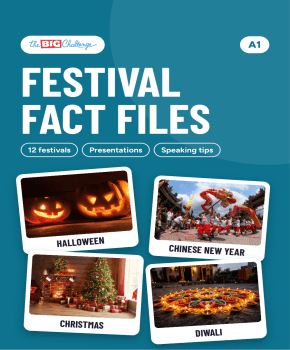
A presentation pack of 12 fact files on festivals and special days: Halloween, Bonfire Night, Thanksgiving, Christmas, Hogmanay, Chinese New Year, Valentine's Day, St Patrick's Day, Easter, Diwali, Burns Night and the Fourth of July. Each festival is a half page with a photo and the same short parts, two festivals to a page to cut in half: at a glance, what people do, food, three special words and a surprising fact. Each pupil or group presents one festival the class has not read. A speaking tips page gives a three-part talk and simple phrases, and a listening grid keeps the class listening. 9 pages with a teacher page.
Documents to download (1)
- Fact files, speaking tips, listening grid In your teacher account
Teaching guide
Objective & content
A presentation pack for A1 classes: twelve fact files on festivals and special days in English-speaking countries and beyond (Halloween, Bonfire Night, Thanksgiving, Christmas, Hogmanay, Chinese New Year, Valentine's Day, St Patrick's Day, Easter, Diwali, Burns Night and the Fourth of July). Every card has the same parts: at a glance (when, where), three things people do, food, three special words and a surprising fact, with a photo. Two festivals share a page: print 6 pages and cut them in half. Each pupil or group presents one festival to classmates who have not read it. By the end, pupils can give a short, simple talk about a festival and pick out information when they listen.
Pedagogical guide
Festivals give pupils concrete, colourful things to say, and every card has the same shape, so pupils know what to say. The language is the present simple (People wear green. Children dress up.), there is / there are (There are fireworks.), dates (on 31 October, in March or April) and "was born" as a fixed phrase. History is given as a date, never as a past-tense story. The three special words on each card are the words of that festival (costume, bonfire, shamrock ...). The speaking tips page gives a three-part talk (Hello! My festival is ... It's on ... / three things / My favourite thing is ... Thank you! Any questions?), five useful phrases and four tips for speaking to the class. The listening grid asks for one thing heard about each festival.
Suggested procedure
One lesson of about 50 minutes.
- (5 min) Show the cover and ask which festivals pupils know. Cut the festival pages in half and give one festival to each pupil or group.
- (10 min) Pupils read their card and prepare a one-minute talk with the speaking tips page. They write key words on the card.
- (25 min) Each group presents its festival. The class listens and writes one thing about each festival in the listening grid.
- (10 min) Pupils answer "Which festival would you like to celebrate? Why?" with "I'd like to celebrate ... because ..." and the class votes.
Adaptations
[S] Pupils present only the at a glance part and one thing people do, reading from their key words card.
[A] Pupils compare the festival with a festival in their own country, or a pupil presents the next festival in the calendar as a warm-up during the year.
Materials & prerequisites
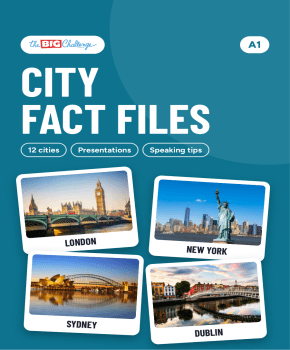
Print factfiles.pdf: the 6 festival pages (pages 1 to 6, two festivals a page, cut in half along the dashed line) so each pupil or group has one festival, the speaking tips page (page 7) and the listening grid (page 8) for everyone; page 9 is the teacher page. Pupils should know the months, dates and the present simple. It goes well with work on festivals, food or the calendar, and with the City and Animal fact files.
Possible adaptations
- Lower levels: Offer segmented listening and additional visual aids.
- Advanced levels: Encourage an oral summary and a debate in English on the theme.
- Large groups: Organise group work with differentiated roles.
🔒 Restricted content
This resource requires a subscription to be viewed.
Unlock the resourceIncluded in the subscription