Australia's first peoples
Interactive exercises to consolidate your students’ learning.
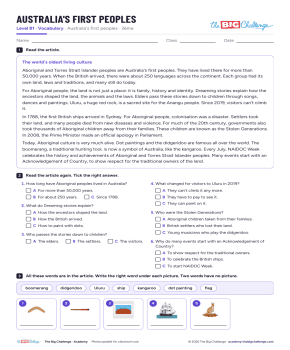
The world's oldest living culture: an article on Aboriginal and Torres Strait Islander peoples, from Dreaming stories and Uluru to colonisation, the Stolen Generations, the 2008 apology and NAIDOC Week. Pupils work through the words of culture, history and identity, from meanings and word forms to collocations, and end on a mystery word; answer key included.
Documents to download (2)
- Colour version In your teacher account
- Black and white version In your teacher account
Teaching guide
Objective & content
This sheet on Australia's first peoples opens on an article, "The world's oldest living culture". Aboriginal and Torres Strait Islander peoples have lived in Australia for more than 50,000 years; the article explains the place of the land and the Dreaming stories, tells what colonisation and the Stolen Generations meant for Aboriginal people, and ends on a culture that is very much alive today, with NAIDOC Week and the Acknowledgement of Country. It carries all the target words in context, from ancestors, elders and sacred site to settlers, apology and traditional owners. By the end, pupils understand and use the words to talk about Aboriginal culture, history and identity.
Pedagogical guide
The vocabulary work comes out of the article, never from a list. Page 1 checks understanding with six multiple-choice questions, then pupils name five pictures (a boomerang, a didgeridoo, Uluru, a ship, a kangaroo) from a box of seven words; two words have no picture. Page 2 matches eight words with their meanings (identity, colonisation, achievements) and six collocations (make an apology, show respect, keep a culture alive). Page 3 uses eight words from a box of ten in new sentences, turns nouns into adjectives with -al (tradition, traditional), with a worked example and five items, and ends on a mystery word: seven clues from the article spell RESPECT. It is the hardest task, as pupils recall the words with no box to help them. Every task tests words, never grammar. Keep the talk factual and respectful: colonisation and the Stolen Generations are part of the story, and so is a culture that is very much alive today.
Suggested procedure
- (5 min) Show Australia and Uluru on a map; ask pupils what they know about Australia's first peoples.
- (10 min) Pupils read the article and answer the six questions, then name the pictures.
- (10 min) Page 2: match the meanings, then the collocations.
- (20 min) Page 3: complete the eight sentences, change the nouns into adjectives, then find the mystery word.
- (10 min) Correct with the answer key on pages 4 and 5; pupils read their clue answers aloud.
Adaptations
[S] Read the article aloud together first; show Australia and Uluru on a map.
[A] After the collocations, pupils write three sentences about why culture and languages matter.
Materials & prerequisites
One copy per pupil of the three pupil pages, in colour or black and white. Pages 4 and 5 are the answer key with teacher notes: keep them. Pupils should know the past simple, the present perfect with for, relative clauses and have to. The sheet has no writing task; to take it further, pupils research NAIDOC Week or an Aboriginal artist and present them to the class in one minute.
Possible adaptations
- Lower levels: Offer segmented listening and additional visual aids.
- Advanced levels: Encourage an oral summary and a debate in English on the theme.
- Large groups: Organise group work with differentiated roles.
🔒 Restricted content
This resource requires a subscription to be viewed.
Unlock the resourceIncluded in the subscription