Food and meals
Interactive exercises to consolidate your students’ learning.
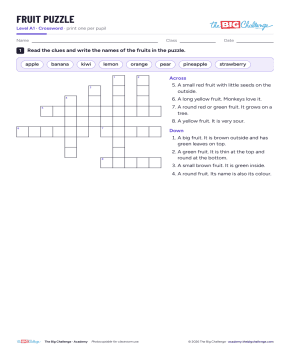
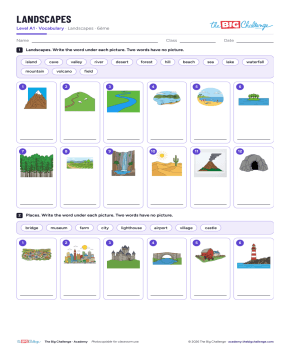
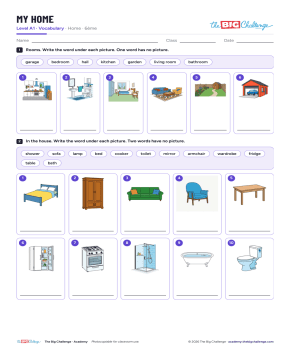
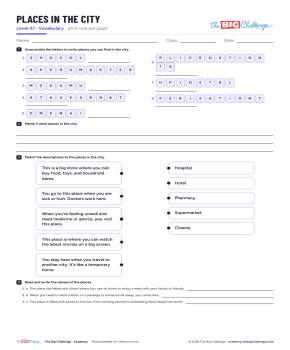
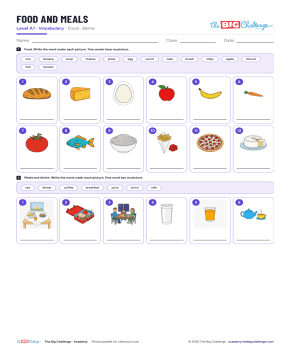
Ben's meals in a day, from cereal at breakfast to fish and chips on Friday, carry everyday food, drinks and meal words. Pupils name pictures, answer questions on his text, match a cup of and a packet of, unscramble words and finish with a crossword; answer key included.
Documents to download (2)
- Colour version In your teacher account
- Black and white version In your teacher account
Teaching guide
Objective & content
This sheet teaches everyday food and drinks, the meals of the day and words such as hungry, thirsty and delicious. Pupils name food, drinks and meals from pictures, then read Ben's text about what he eats in a day and answer six multiple-choice questions. They match containers with food (a cup of tea, a packet of biscuits) and complete ten sentences, unscrambling the letters given in brackets. The last task, the hardest, is a food crossword with clues and no word list: pupils recall and spell the words.
Pedagogical guide
The words move from recognising to using: pictures first, then the words in Ben's text, then new sentences, then the crossword, where nothing is given but the clue. Each task tests words only, never grammar, and every item has one answer. The grammar stays on the 6ème floor: the present simple of have, like, make and be, with some and a. Biscuit, cereal, dessert and vegetables are above A1 in our word lists, taught here because they name the topic.
Suggested procedure
- (5 min) Show real food packaging; the class names the food they know.
- (10 min) Activities 1 and 2: pupils write the word under each picture. Some words in the box have no picture.
- (10 min) Activities 3 and 4: read Ben's text aloud, then pupils tick the right answers.
- (5 min) Activity 5: pupils match the two halves (a bowl of cereal).
- (15 min) Activities 6 and 7: the scrambled words, then the crossword.
- (5 min) Check with the answer key on page 4.
Adaptations
[S] Bring real food packaging for page 1.
[A] Pupils write what they eat in a day, using five words from page 1.
Materials & prerequisites
One copy per pupil, three pupil pages. Page 4 is the answer key: keep it. To take it further, pupils draw their perfect lunchbox and label eight things, then tell a partner what is inside, or write a short food poem.
Possible adaptations
- Lower levels: Offer segmented listening and additional visual aids.
- Advanced levels: Encourage an oral summary and a debate in English on the theme.
- Large groups: Organise group work with differentiated roles.
🔒 Restricted content
This resource requires a subscription to be viewed.
Unlock the resourceIncluded in the subscription