Friendship
Interactive exercises to consolidate your students’ learning.
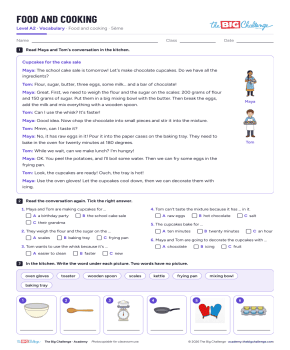
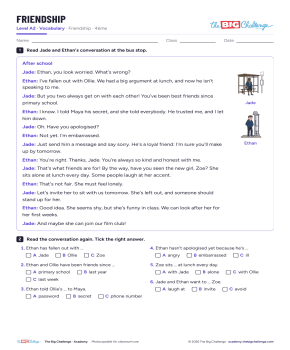
Friendship, arguments and making up, through Jade and Ethan at the bus stop: Ethan has let his best friend down, and a new girl sits alone at lunch. Pupils label pictures, match adjectives, use phrasal verbs and finish with an advice column; answer key included.
Documents to download (2)
- Colour version In your teacher account
- Black and white version In your teacher account
Teaching guide
Objective & content
This sheet on friendship starts from a conversation between Jade and Ethan at the bus stop after school. Ethan has fallen out with his best friend, Ollie, because he told Ollie's secret, and Jade tells him to say sorry; then the two friends decide to invite Zoe, a new girl who sits alone at lunch. Pupils answer six multiple-choice questions, label six pictures from a box of eight expressions such as make up and be left out, match eight adjectives such as loyal, honest and jealous with their meanings, complete eight sentences and use phrasal verbs from the conversation, given whole in a box. The last and hardest task is an advice column, "My best friend has a new friend", with a choice of three words in each bracket.
Pedagogical guide
The conversation carries the words of the topic, so pupils meet each one before working on it. Every phrasal verb appears first in the conversation, then whole in a box: pupils never have to guess a particle. The tasks go from recognising words to using them: pictures, meanings, new sentences, then phrasal verbs. Zoe's story stays simple: a new pupil is left out, and the two friends choose to include her, so the class can talk about it without a lecture. In the advice column, each choice is settled by the words around it, so pupils should read the whole sentence before they circle. Every task tests words, never grammar.
Suggested procedure
- (5 min) Pupils say three qualities of a good friend; write them on the board.
- (10 min) Two pupils read the conversation aloud; the class answers the six questions.
- (8 min) Pupils label the pictures, then match the adjectives with their meanings.
- (8 min) Pupils complete the sentences; remind them that two words are extra.
- (7 min) Do the phrasal verb example together, then pupils complete the sentences; one verb is extra.
- (10 min) Pupils read the advice column and circle the words; check with the answer key on page 4.
Adaptations
[S] Read the conversation aloud in two voices before pupils work alone.
[A] Pupils write a short message to the advice column about a friendship problem, real or invented, for a partner to answer. To take it further, the class makes a poster: "How to be a good friend".
Materials & prerequisites
One copy of the three pupil pages per pupil, in colour or in black and white. Page 4 is the answer key: keep it. Pupils should know the past simple of common verbs and should for advice.
Possible adaptations
- Lower levels: Offer segmented listening and additional visual aids.
- Advanced levels: Encourage an oral summary and a debate in English on the theme.
- Large groups: Organise group work with differentiated roles.
🔒 Restricted content
This resource requires a subscription to be viewed.
Unlock the resourceIncluded in the subscription