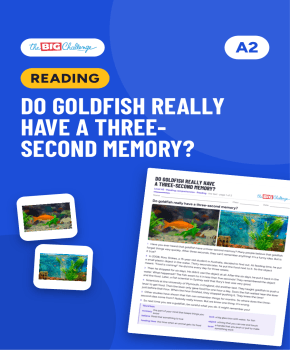
Reading A2: Do Goldfish Really Have a Three-Second Memory?
Interactive exercises to consolidate your students’ learning.
An A2 reading about goldfish: do they really forget everything after three seconds? A 15-year-old student's experiment in Australia and a test in England give the answer. One text with a word box, ten questions and a pair speaking task, test a pet's memory, plus an answer key; 30 to 40 minutes.
Documents to download (2)
- Reading comprehension In your teacher account
- Reading comprehension (black and white) In your teacher account
Teaching guide
Objective & content
An A2 reading that tests a famous idea: goldfish have a three-second memory. The text tells how the idea was tested. In 2008, Rory Stokes, a 15-year-old student in Australia, put a small plastic object in his fish tank at feeding time for three weeks, then stopped for six days. When he put the object back, the fish swam to it in less than five seconds: they remembered. In England, scientists at the University of Plymouth taught goldfish to push a lever for food, and the fish learned the time when the food came. The text ends with a smile: next time you see a goldfish, it might remember you. By the end, pupils can follow a short true story about an experiment, find facts in a text, and plan a simple test of their own. It is part of the Reading A2 set: one-text readings with the same layout.
Pedagogical guide
The sheet has one text of about 240 words at A2, with short sentences of 13 words or fewer, and a word box with six words explained in English (memory, tank, believe, object, feeding time, lever). The ten questions go from finding information to giving an opinion: three choices, true or false and one gap to complete first, then "Why do you think people believe the three-second idea?" and "Do you have a pet, or would you like one? What can it remember?" The story is told in the past simple (put, swam, knew, stopped), and pupils also meet the present perfect in natural use ("Have you ever heard ...?", "Other studies have shown ..."); no question tests it. The speaking task puts the text to work: in pairs, pupils plan a memory test for a pet in three steps. Every fact comes from published reports of the two experiments.
Suggested procedure
- (5 min) Warm-up: show the two photos and ask "Can a goldfish remember things? For how long?"
- (10 min) Pupils read the text alone. They can use the word box.
- (10 min) Pupils answer questions 1 to 10, then check in pairs. Correct together with the key; for 9 and 10, take two or three answers.
- (10 to 15 min) Speaking task: in pairs, pupils choose a pet (a dog, a cat, a rabbit or a fish), plan a test of its memory in three steps with "First, you ...", "Then you wait for ..." and "If the pet remembers, it ...", then tell the class.
Adaptations
[S] Go through the word box first, with the photos. Before question 5, read paragraph 3 again together. Pupils can answer questions 1 to 8 only, and say one step of their test.
[A] Pupils write their pet test as a short report in the past simple, as if they had done it: what they did, what happened and what it shows. They can also find another animal myth and say if it is true.
Materials & prerequisites
The sheet in colour or low ink (the low-ink version has no pictures), one copy per pupil: pages 1 and 2 are for pupils, page 3 is the answer key. A screen to show the photos for the warm-up. Pupils should know the past simple, regular and irregular.
Possible adaptations
- Lower levels: Offer segmented listening and additional visual aids.
- Advanced levels: Encourage an oral summary and a debate in English on the theme.
- Large groups: Organise group work with differentiated roles.
🔒 Restricted content
This resource requires a subscription to be viewed.
Unlock the resourceIncluded in the subscription