The school office
Episode of the series Listen Up!
- Illustrated slideshow (2 images)
- Comprehension quiz (17 questions)
 Extract · 30 s
The episode
Listen, then answer. Listen to a conversation (the school office), then answer the questions. Can you catch the details?
Teaching guide
Objective & content
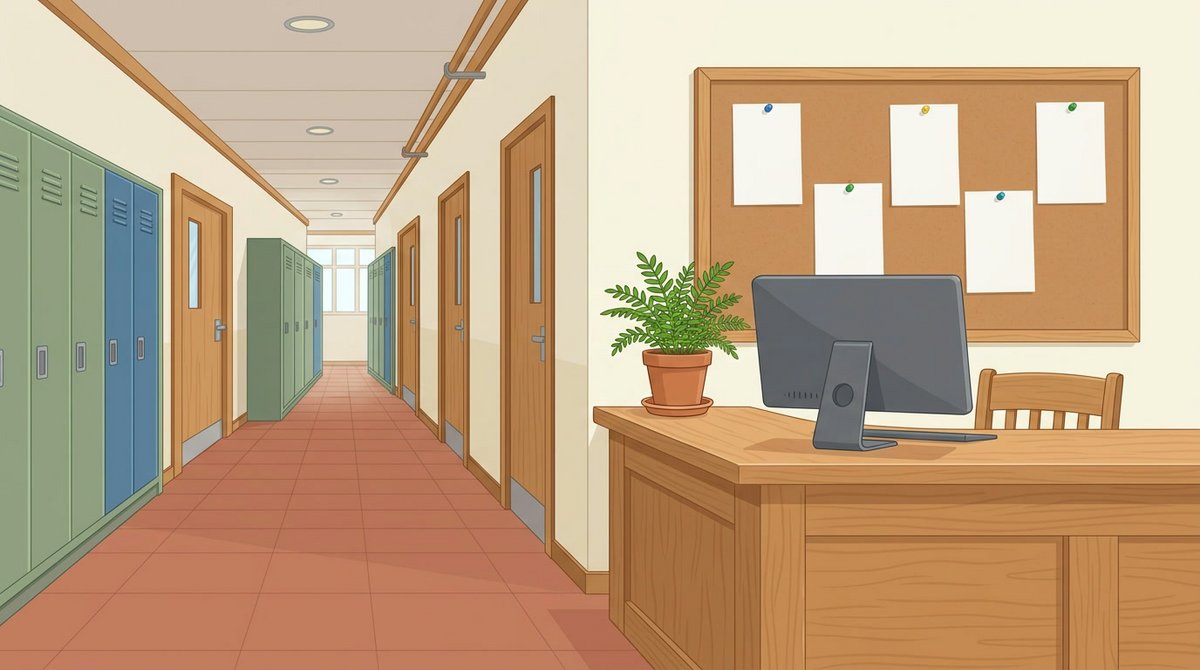
This is a short everyday conversation, about one minute long, to listen to and then answer: Mateo, 11, and his dad talk to Mrs Hall, the school secretary, on Mateo's first day, with a name spelled out, a class, a first lesson, a room, a floor and times to catch. The script is not shown in the app: pupils only listen, and a picture of an empty school reception desk shows during the opening sound, then fades. The language is the language of giving personal information: questions with be (What's your name? Where's the maths room?), can for requests ("Can you spell that, please?"), a present simple question with does (what time does school finish?), the alphabet for spelling, times such as half past three, and on for floors, with the words spell, mistake, timetable, floor and finish. In the app, pupils answer 18 questions: listening (gist, then detail), words and useful phrases. The script is for the teacher, as a transcript for an optional follow-up in class.
Pedagogical guide
The episode is made for pupils to do on their own: in class on a tablet or in the computer room, or at home. Each pupil listens with headphones, as many times as they need, and answers the 18 questions in order. The listening questions come first, gist then detail, so the first listen is for the general idea (why Mateo is at the school office and what the problem is) and the next ones are for the details (the spelled surname, the class, the first lesson, the time, the room and the floor, and when school finishes). Pupils pause and replay the audio themselves; the picture fades so they listen instead of looking. There is no script and no translation on screen: a pupil who doesn't know a word looks it up in a dictionary. The teacher's part is short: set the task, look at the results, and, if there is time, run the short follow-up in class below. The lesson plan gives a whole-class version for a teacher who prefers to play the episode to the class.
Suggested procedure
For the pupil (about 15 minutes):
- Listen once, without stopping, for the general idea: why Mateo is at the school office and what the problem is.
- Answer the first listening questions.
- Listen again, and pause when you need to. On a piece of paper, write down the spelled surname, the class, the first lesson, the time, the room and the floor, and when school finishes.
- Answer the detail questions, then the words and the useful phrases.
- For each wrong answer, listen to that part again and find what you missed.
Back in class (optional, about 10 minutes):
- Look at the questions most pupils got wrong, and play those lines again together.
- Hand out the script as a transcript: pupils find the line for each answer.
- Role-play: in threes, with the pupils' own names, a new class and a new lesson.
Materials & prerequisites
- The episode in the app (the audio, the scene picture and the 18 questions), on one device per pupil, with headphones.
- A piece of paper for notes.
- For the follow-up in class only: the script, printed as a transcript, one copy per group of three.
- Prerequisites: the alphabet, numbers and times in English, and school subjects.
Possible adaptations
- Lower levels: Offer segmented listening and additional visual aids.
- Advanced levels: Encourage an oral summary and a debate in English on the theme.
- Large groups: Organise group work with differentiated roles.
🔒 Restricted content
This resource requires a subscription to be viewed.
Unlock the resourceIncluded in the subscriptionTags
- Question forms
- Wh- questions
- Present simple
- School life
- Timetable
- Alphabet
- Telling the time
- Everyday Life
- Listening comprehension
- Functional language
- Vocabulary building