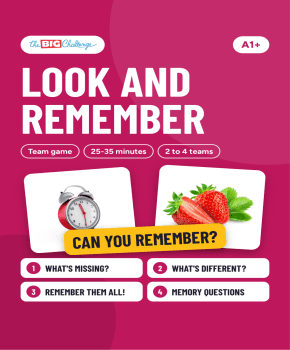
Look and Remember
A teaching resource designed to energise your English lessons.
Pupils look at a tray of photos for 20 or 30 seconds, then the tray disappears and 2 to 4 teams say what is missing, what has changed, everything they remember, and what colour or how many things there were. Four rounds (What's missing?, What's different?, Remember them all! and Memory questions) over 36 slides, with everyday objects, fruit, clothes, food and animals. For A1+, about 25 to 35 minutes.
Documents to download (1)
- Colour version In your teacher account
Teaching guide
Objective & content
A projected team memory game (Kim's game) with photos, for one game of 25 to 35 minutes. A tray of pictures shows for 20 or 30 seconds, then it disappears and the class plays in 2 to 4 teams through four rounds: What's missing? (one picture has gone), What's different? (one picture has been swapped for another, 2 points), Remember them all! (write every thing you remember from a tray of eight) and Memory questions (answer four questions about colours and numbers, such as "What colour was the hat?" and "How many kittens were there?"). Pupils recall and write the names of everyday objects: school things, fruit, clothes, food, animals, things at home, transport and technology, and use colours and numbers to describe what they saw. There are 10 trays over 36 slides.
Pedagogical guide
The game plays unlike a quiz: there is no general knowledge to have and no clue to read. Everything depends on looking carefully and on knowing the words, so pupils who know the vocabulary well but are not the first to answer in other games can do very well. Round 1 is the gentlest: the trays are small (six or eight pictures) and only one picture goes, so the answer is a single word. Round 2 asks for more, because pupils must say which picture changed and what it changed into ("The apple is now a tomato."), which is worth 2 points. Round 3 is the only round where the answer is a list: each team writes as many things as it can remember from a tray of eight, one point each. Round 4 turns memory into short questions with "was" and "were" ("How many ice creams were there?", "What colour was the clock?"), and pupils answer with a colour or a number ("Pink." "Three."). The vocabulary is everyday and the level stays at A1+, in British English. Teams that can only answer with one word get the point; teams that want to may answer in a sentence ("It was blue."). Useful language for the teams: "I think it's ...", "The ... is missing.", "I remember a ...", "There were three ...", "It was red."
Suggested procedure
- (3 min) Make 2 to 4 teams and draw a score table on the board. Each team has one sheet of paper and one writer. Explain the rule: "Pens down while we look!"
- (6 min) Round 1, What's missing?: show the tray for 20 seconds, then show the next slide, where one picture has gone. Teams write the missing word. 1 point for each right answer; the answer slide shows the full tray again.
- (7 min) Round 2, What's different?: show the tray for 20 seconds, then the changed tray. Teams write the picture that changed and what it is now. 2 points for each right answer.
- (8 min) Round 3, Remember them all!: show the tray of eight for 30 seconds, then hide it. Teams write everything they remember. 1 point for each thing, checked against the answer slide.
- (8 min) Round 4, Memory questions: show the tray for 30 seconds, hide it, then ask the four questions one by one. 1 point for each right answer.
- (2 min) Add up the points on the board and congratulate the winning team.
Adaptations
[S] Give 30 seconds instead of 20 in rounds 1 and 2, and let teams say the word instead of writing it. In round 3, accept a drawing next to the word, and let teams work in pairs. In round 4, ask the question twice, slowly, and let teams answer with one word.
[A] In round 3, ask teams to write short phrases with a colour or a number ("a yellow clock", "three trophies"). In round 4, ask for a full answer ("The boots were pink.", "There were two kittens.") and let teams write their own memory question for the other teams.
Materials & prerequisites
A projector or screen for game.pdf (36 slides in 16:9, one PDF page per slide, turned with the arrow keys), the board for the score table, and a sheet of paper and a pen for each team. Pupils should already know the names of common objects, fruit, clothes, food and animals, the colours, the numbers from one to ten, and "How many ...?" and "What colour ...?". The game works well as a revision game at the end of a unit on everyday vocabulary, or as a reward at the end of a lesson.
Possible adaptations
- Lower levels: Offer segmented listening and additional visual aids.
- Advanced levels: Encourage an oral summary and a debate in English on the theme.
- Large groups: Organise group work with differentiated roles.
🔒 Restricted content
This resource requires a subscription to be viewed.
Unlock the resourceIncluded in the subscription