Reading B1+: Can You Train Your Memory?
Interactive exercises to consolidate your students’ learning.
A B1+ reading about memory: are memory champions born with a special brain, or can anyone learn their trick? Three studies give the answer, and brain-training apps get a surprise. One text with a word box, ten questions and a pair speaking task, build a memory palace, plus an answer key; 30 to 40 minutes.
Documents to download (2)
- Reading comprehension In your teacher account
- Reading comprehension (black and white) In your teacher account
Teaching guide
Objective & content
A B1+ reading about a question every pupil cares about before a test: can you train your memory? The text presents three studies. In London, scientists found that memory champions were no more intelligent than other people: nine of ten used the same trick, the "memory palace", already used by the ancient Greeks. In the Netherlands, ordinary people who practised it for 40 days went from about 26 words out of 72 to 62, and still remembered more four months later. A BBC study of more than 11,000 viewers showed that brain-training apps only make you better at the games. By the end, pupils can follow a short popular-science text, explain how a method works, and try it for themselves. It is part of the Reading B1+ set: one-text readings with the same layout.
Pedagogical guide
The sheet has one text of about 380 words at B1+, with no sentence longer than 20 words, and a word box with six words explained in English (champion, intelligent, trick, picture, practise, method). The ten questions go from finding information to explaining it: three choices or true or false first, then "How does a memory palace work? Explain in your own words." and "Would you try a memory palace? What would you use it for?" The text models the passive (they were compared, this trick was already used, they were put into three groups) and the present perfect (you have forgotten, you may have seen). The speaking task turns the text into an experiment: pupils use a memory palace to remember a list of ten words. Every fact comes from published research on memory.
Suggested procedure
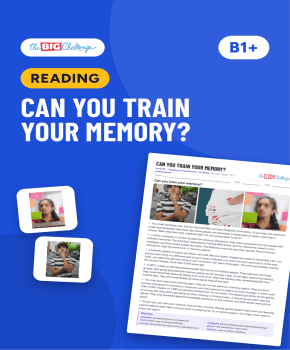
- (5 min) Warm-up: show the three photos and ask "How do you remember things: names, words for a test, a shopping list?"
- (10 min) Pupils read the text alone. They can use the word box.
- (10 min) Pupils answer questions 1 to 10, then check in pairs. Correct together with the key; for 9 and 10, take two or three answers.
- (10 to 15 min) Speaking task: in pairs, one pupil reads a list of ten words slowly and the other uses a memory palace, their home or the school, to remember them; then they swap and tell the class how many words they remembered, and why.
Adaptations
[S] Go through the word box first. Before the speaking task, model a memory palace on the board with three objects in your classroom. Pupils can answer questions 1 to 8 only, and remember a list of five words.
[A] Pupils use a memory palace to learn the word box, or their next list of vocabulary, and test each other the next day. They can also write a short guide, "How to build a memory palace", in the imperative.
Materials & prerequisites
The sheet in colour or low ink (the low-ink version has no pictures), one copy per pupil: pages 1 and 2 are for pupils, page 3 is the answer key. A screen to show the photos for the warm-up. Pupils should know the past simple and have met the passive and the present perfect.
Possible adaptations
- Lower levels: Offer segmented listening and additional visual aids.
- Advanced levels: Encourage an oral summary and a debate in English on the theme.
- Large groups: Organise group work with differentiated roles.
🔒 Restricted content
This resource requires a subscription to be viewed.
Unlock the resourceIncluded in the subscription