Reading B1+: A face on the six o'clock news
Interactive exercises to consolidate your students’ learning.
Oriini Kaipara read the six o'clock news in New Zealand with a moko kauae, the traditional chin tattoo of Māori women. This B1+ reading tells what the moko means, how the custom nearly disappeared and came back, and how she answered a viewer who called it "offensive". One text with a word box, ten questions and a group task, Who do we see?, plus an answer key; 30 to 40 minutes.
Documents to download (2)
- Reading comprehension In your teacher account
- Reading comprehension (black and white) In your teacher account
Teaching guide
Objective & content
In the last week of December 2021, the journalist Oriini Kaipara read the six o'clock news in New Zealand with a moko kauae, the traditional chin tattoo of Māori women, which shows who a woman is and which family and people she comes from. This B1+ reading explains why the sight made news around the world. After the British took control in the nineteenth century, missionaries disliked the moko and the custom nearly died: in the early 1970s the historian Michael King found only 72 women who wore one, all old. Young Māori then began to fight for their land and their language, artists learned the art again, and since 1990 more and more women and men have chosen to wear one; in 2016 Nanaia Mahuta became the first woman in Parliament with a moko kauae. Kaipara received hers in January 2019 and that year became the first person with a moko kauae to present the news on a national channel. In 2022 a viewer called her moko "offensive", and she answered him in public. Since 2025 she has been a member of Parliament. By the end, pupils can explain what a moko kauae means, how a tradition nearly disappeared and came back, and why it matters who is seen on the news. It is part of the Reading B1+ set: one-text readings with the same layout, in a group of readings on how people show themselves and see others (beauty standards, norms, identity).
Pedagogical guide
The sheet has one text of about 329 words at B1+, with no sentence longer than 20 words, and a word box with six words explained in English (chin, missionary, custom, foreign minister, viewer, offensive). The ten questions go from finding information to explaining it: three choices, true or false with the words that prove the answer, a number to complete and a word to find, then "Why did Kaipara tell the viewer to keep his ideas for the 1800s?" and "Why does it matter who reads the news on television?" The text models the passive (Her tattoo is called a moko kauae), the present perfect with since (Since 1990, more and more women and men have chosen to wear one) and reported speech (she told him to keep his ideas for another lifetime). The speaking task is group work: pupils look at who presents the news, sport and weather in their country and say who they rarely see.
Suggested procedure
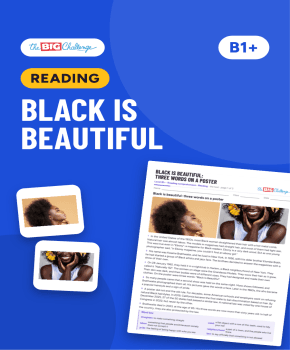
- (5 min) Warm-up: show the photos and ask "Who do you usually see reading the news on television? What do they look like?"
- (10 min) Pupils read the text alone. They can use the word box.
- (10 min) Pupils answer questions 1 to 10, then check in pairs. Correct together with the key; for 9 and 10, take two or three answers.
- (10 to 15 min) Speaking task, Who do we see?: in groups, pupils think of the people who present the news, sport and weather on television in their country and ask whether they look like the people in their street. They find one group of people that they rarely see on screen, and explain to the class why it would matter to see them and what might change.
Adaptations
[S] Go through the word box first and show New Zealand on a map. Before question 9, read paragraph 6 again together. Pupils can answer questions 1 to 8 only, and name one group of people they rarely see on screen without explaining why.
[A] Pupils watch a few minutes of the news in their own country, note who presents it, and say in five sentences what they noticed.
Materials & prerequisites
The sheet in colour or low ink (the low-ink version has no pictures), one copy per pupil: pages 1 and 2 are for pupils, page 3 is the answer key. A screen to show the photos for the warm-up. Pupils should know the past simple, and have met the present perfect, the passive and reported speech.
Possible adaptations
- Lower levels: Offer segmented listening and additional visual aids.
- Advanced levels: Encourage an oral summary and a debate in English on the theme.
- Large groups: Organise group work with differentiated roles.
🔒 Restricted content
This resource requires a subscription to be viewed.
Unlock the resourceIncluded in the subscription