Multicultural Britain
Interactive exercises to consolidate your students’ learning.
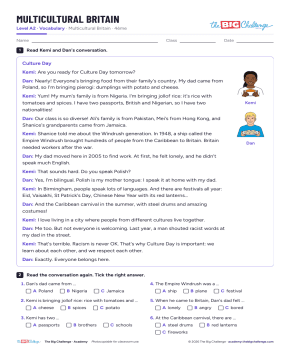
Kemi and Dan get ready for Culture Day at their school in Birmingham: food from their families' countries, two passports, the Windrush generation, the languages and festivals of the city, and how to answer racism. Pupils answer questions, label pictures, match meanings, complete sentences, write nationalities and complete Kemi's article; answer key included.
Documents to download (2)
- Colour version In your teacher account
- Black and white version In your teacher account
Teaching guide
Objective & content
This sheet on multicultural Britain starts from a conversation between Kemi and Dan, two friends in Birmingham, the day before their school's Culture Day. Dan is bringing Polish dumplings, because his dad came from Poland in 2005 to find work; Kemi is bringing jollof rice, because her mum's family is from Nigeria, and she has two passports. They talk about the Windrush generation, being bilingual, a mother tongue, and the festivals of their city. Dan says a man once shouted racist words at his dad, and the two friends answer it together: racism is never OK, and everyone belongs. Pupils learn to talk about cultures, languages and where families come from. They answer six multiple-choice questions, label six pictures with words from a box of eight, match eight words such as diverse, welcoming and to belong with their meanings, complete eight sentences from a box of ten words and write five nationalities. The sheet ends with Kemi's article for the school website, with nine words to choose in brackets.
Pedagogical guide
The conversation carries the words of the topic, so pupils meet each one in context before working on it. Migration is told through one family's story, and racism is named once, plainly, and answered by the two friends; it is never shown in the pictures, which show food and objects (a passport, a ship, a steel drum). Let pupils share their own family story only if they want to. The word-form task asks for one kind of change, countries and nationalities, and opens with a worked example (Poland, Polish); pupils must watch the spelling (Pakistani, Chinese). The tasks go from recognising words to using them, and the last task is the hardest: each bracket offers three words of the topic, so pupils must read the whole sentence. Every task tests words, never grammar. The facts are checked: the Empire Windrush brought hundreds of people from the Caribbean to Britain in 1948.
Suggested procedure
- (5 min) Ask "Which languages do people speak in your town? Which festivals do they celebrate?" and write the answers on the board.
- (10 min) Two pupils read the conversation aloud; the class answers the six questions.
- (8 min) Pupils label the six pictures, then match the eight words with their meanings.
- (8 min) Pupils complete the sentences with the words in the box.
- (7 min) Read the worked example together; pupils write the five nationalities.
- (7 min) Pupils read Kemi's article and circle the right word in each bracket.
- (5 min) Check with the answer key on page 4.
Adaptations
[S] Pupils list the languages and festivals they know in their town before reading.
[A] Pupils write four sentences about the cultures in their school or town. To take it further, the class holds its own Culture Day, like Kemi and Dan's.
Materials & prerequisites
One copy of the three pupil pages per pupil, in colour or in black and white. Page 4 is the answer key: keep it. Pupils should know the present simple, the present continuous for plans, and the past simple.
Possible adaptations
- Lower levels: Offer segmented listening and additional visual aids.
- Advanced levels: Encourage an oral summary and a debate in English on the theme.
- Large groups: Organise group work with differentiated roles.
🔒 Restricted content
This resource requires a subscription to be viewed.
Unlock the resourceIncluded in the subscription