The Big Nature Quiz
A teaching resource designed to energise your English lessons.
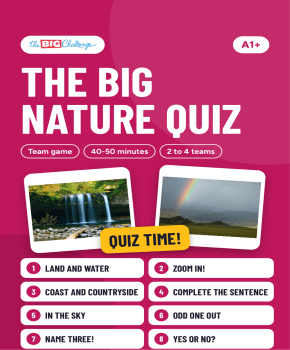
Pupils play a projected team quiz on nature vocabulary, with photos: 2 to 4 teams go through eight rounds (Land and water, Zoom in!, Coast and countryside, Complete the sentence, In the sky, Odd one out, Name three! and Yes or no?) and meet about 50 words for landscapes, water, the coast, the sky, the weather and the parts of a tree. 45 questions, 54 points, each question followed by its answer slide. For A1+, about 40 to 50 minutes.
Documents to download (1)
- Colour version In your teacher account
Teaching guide
Objective & content
A projected team quiz on nature vocabulary, with real photos, for one game of 40 to 50 minutes. The class plays in 2 to 4 teams through eight rounds: Land and water (a photo and a word bank: mountain, river, lake, waterfall, volcano, island, desert, forest), Zoom in! (a close-up of a leaf, an acorn, bark or sand), Coast and countryside (a word bank: beach, cliff, cave, wave, iceberg, valley, hill, field), Complete the sentence (a gap and a word bank), In the sky (clouds, rainbow, lightning, fog, snow, the moon, stars, a sunset), Odd one out, Name three! and a short Yes or no? There are 45 questions and 54 points. Pupils meet about 50 nature words, with no animals.
Pedagogical guide
Every question slide is followed by its answer slide, so the class sees the answer at once and the teacher only keeps the score. The quiz tests vocabulary. Three rounds keep a word bank on the screen (land and water, the coast and countryside, the sky), so pupils choose the word instead of spelling it from memory. The answer slide sometimes adds a short sentence ("A valley is the low land between hills or mountains.", "An iceberg is ice in the sea."): read it aloud and let pupils notice a/an and there is/there are. Zoom in! shows a close-up first: pupils guess, then see the whole photo. Complete the sentence gives six short sentences with a gap and a word bank (leaves, roots, branches, sea, stream, top), which covers the parts of a tree. Odd one out is worth 2 points: pupils find the word that does not belong and say why (a valley goes down; a hill, a mountain and a volcano go up). Name three! asks for three words, 1 point each, so several answers are right. Yes or no? has only three general-knowledge questions (for example, "Is a desert always hot?") and is a light finish. The quiz stays at A1+ level, with short sentences in the present simple, in British English. Useful language for the teams: "I think it's a cliff.", "It's a lake.", "There are clouds in the sky."
Suggested procedure
- (3 min) Make 2 to 4 teams and draw a score table on the board. Each team has one sheet of paper and one writer.
- (6 min) Round 1, Land and water: show the photo, leave the word bank on the screen and give 20 seconds; teams write the word. Show the answer slide. 1 point for each right answer.
- (5 min) Round 2, Zoom in!: show the close-up; teams write what it is. Then show the whole photo and the answer. 1 point for each right answer.
- (6 min) Round 3, Coast and countryside: same as round 1, with a new word bank. 1 point for each right answer.
- (5 min) Round 4, Complete the sentence: read the sentence aloud; teams write the missing word from the word bank. 1 point for each right answer.
- (6 min) Round 5, In the sky: show the photo with the word bank; teams write the word. 1 point for each right answer.
- (5 min) Round 6, Odd one out: read the four words; teams write the number of the odd one. 2 points for each right answer. Read the reason on the answer slide.
- (5 min) Round 7, Name three!: teams write three words. 1 point for each right word (3 points a question). Accept any word on the answer slide and any other sensible one.
- (3 min) Round 8, Yes or no?: read the question; teams write Yes or No. 1 point for each right answer. Read the reason on the answer slide.
- (2 min) Add up the points on the board and show the last slide, "Who won?".
Adaptations
[S] In rounds 1, 3 and 5, let teams point to the word in the box or say it instead of writing, and read each sentence in round 4 twice, slowly. Do the first question of each round together before the teams write.
[A] In rounds 1, 3 and 5, ask teams for a full sentence ("It's a lake.", "There is a waterfall."). In round 6, ask for the reason ("A valley goes down."). In round 7, ask for more than three words.
Materials & prerequisites
A projector or screen for game.pdf (100 slides in 16:9, one PDF page per slide, turned with the arrow keys), the board for the score table, and a sheet of paper and a pen for each team. Pupils should already know a few everyday nature words (tree, sea, sun, rain) and the articles a and an. The quiz works well as a revision game at the end of a unit on nature, places or the weather, or as a reward at the end of a lesson.
Possible adaptations
- Lower levels: Offer segmented listening and additional visual aids.
- Advanced levels: Encourage an oral summary and a debate in English on the theme.
- Large groups: Organise group work with differentiated roles.
🔒 Restricted content
This resource requires a subscription to be viewed.
Unlock the resourceIncluded in the subscription