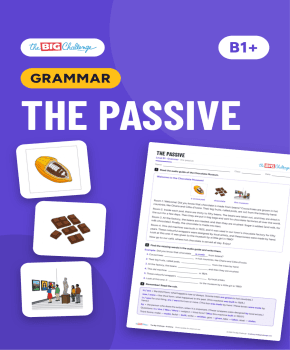
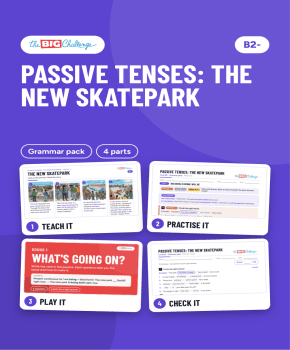
The passive: Lost and found
Interactive exercises to consolidate your students’ learning.
Everything to teach the passive: slides to project, a three-level practice sheet, a team game and a 10-minute quiz with answers. The school's lost property box is opened on the last day of term: a guitar was left on the bus, trainers were found on the roof. Pupils then learn is / are / was / were + third form, why we use the passive, by + the person, negatives and questions, and active or passive. The game is about strange school news, like a sheep found in a classroom. For B1+, two lessons of about 45 minutes.
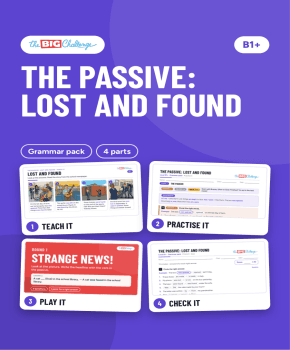
Documents to download (4)
- Teach it: lesson slides In your teacher account
- Practise it: three-level sheet In your teacher account
- Play it: team game In your teacher account
- Check it: quiz and key In your teacher account
Teaching guide
Objective & content
Everything to teach the passive, in one pack of four parts: slides to project, a three-level practice sheet, a team game and a 10-minute quiz with answers. The pack starts from a short story in the school newspaper: on the last day of term, the lost property box is opened. A guitar was left on the school bus and found by the driver, a pair of trainers was found on the roof of the sports hall, and a lunch box lost in September wasn't opened. Pupils meet the structure in the story before they meet the rule. The pack teaches the passive in the present simple and the past simple (is / are / was / were + third form), why we use it (we don't know who did it, it isn't important, or the thing matters more than the person), by + the person only when it is useful, negatives and questions (The lunch box wasn't opened. Where were the trainers found?), and the choice between active and passive in the same tense. By the end, pupils can report what happened when nobody knows who did it, and change active sentences into the passive.
Pedagogical guide
The rule is given in Remember! boxes, not left to be deduced; the story and its pictures make the structure easy to notice first. The practice sheet is one A4 sheet at three levels: every page has a Bronze, a Silver and a Gold task, so the whole class works on the same page and each pupil moves up when they finish. The Gold task on page 3 asks pupils to write their own lost property story. The team game, "Strange but true?", is about strange school news drawn for the pack (a sheep found in a classroom, a teacher's car covered in sticky notes, a snowman built on the school roof); in the last round, teams write the verb and decide whether a fact is true or made up (the Mona Lisa was stolen in 1911: true). Every round opens with a worked example. The quiz gives a mark out of 20. The pack stays at B1+ level: only the present and past simple passive; other tenses (will be, has been) and It is said that ... are left for B2. The key page of the practice sheet holds the answers, teacher notes and seven common mistakes (for example "The guitar was find", "Where did the trainers found?" and "The box didn't opened"). Spelling is British English.
Suggested procedure
The pack fits two lessons of about 45 minutes. Lesson 1 is Teach it and Practise it; lesson 2 is Play it and Check it. The four parts can also be used alone.
- (25 min) Teach it (lesson.pdf, lesson 1): show the four pictures and ask "What's in the box? Where were the trainers?", then read the story together. Read the Remember! boxes aloud; pupils find every was and were + third form in the story. Ask "Who found the guitar? Who put the trainers on the roof?" to show when we use by. Say an active sentence; pupils say it in the passive. Then do the six-question quick check with the class. The last slide is for the teacher and is not projected.
- (20 min) Practise it (practice.pdf, lesson 1): give each pupil the three pages and a start (Bronze, Silver or Gold); correct page by page, with one pupil from each medal reading an answer.
- (25 min) Play it (game.pdf, lesson 2): make teams and read each round's example together. Show each question, give 20 seconds to write the answer, then show the answer slide and keep the score. Round 4 is worth double points: one for the verb, one for true or made up.
- (10 min) Check it (quiz.pdf, lesson 2): pupils work alone on page 1; mark out of 20 with page 2.
Adaptations
[S] Start every pupil at Bronze and keep the Remember! slides on screen during the practice and the game. Give them a card with the pattern (was / were + third form) and a list of third forms, and do the quiz in two halves.
[A] Send fast pupils straight to Gold and then to the Gold writing task on page 3, where they write their own lost property story; a partner asks one question in the passive (Where was it found?). In the game, ask them for a second sentence about each picture.
Materials & prerequisites
A projector or screen for lesson.pdf and game.pdf (one PDF page per slide, turned with the arrow keys), and paper for the teams' answers. Print practice.pdf (3 pages for pupils; the key page is for the teacher) and quiz.pdf (page 1 for pupils, page 2 is the key), one copy per pupil. Pupils should already know the past simple and common third forms (found, left, lost, made, taken, seen).
Possible adaptations
- Lower levels: Offer segmented listening and additional visual aids.
- Advanced levels: Encourage an oral summary and a debate in English on the theme.
- Large groups: Organise group work with differentiated roles.
🔒 Restricted content
This resource requires a subscription to be viewed.
Unlock the resourceIncluded in the subscription