Who's Who?
Interactive exercises to consolidate your students’ learning.
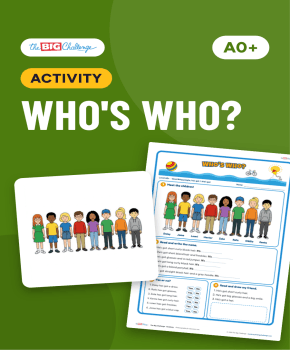
Eight children stand in a row, each with a name. Pupils read six descriptions ("She's got short blond hair and freckles.") and write the right name, then circle Yes or No for six sentences about the children. Last, they read about a friend and draw him. Answer key included.
Documents to download (2)
- Colour version In your teacher account
- Black and white version In your teacher account
Teaching guide
Objective & content
This activity sheet is about describing people. At the top of the page, eight children stand in a row with their names under them: Daisy, Jomo, Lowri, Hector, Zola, Rafe, Ottilie and Kenta. Each one looks different: long or short hair, curly or straight, red, blond, black or brown, glasses, freckles, a cap, a ponytail, and clothes of different colours. Pupils read descriptions and find the right child, decide if sentences about the children are true, and draw a friend from a description. By the end, pupils understand and use he's got and she's got to describe someone ("She's got long curly black hair.").
Pedagogical guide
Everything on the sheet points back to the picture in Task 1, so pupils check each answer with their eyes. Task 2 gives six descriptions ("He's got glasses and a red jumper.") and pupils write the name after "It's". Each description fits one child only, but some need a second look: Daisy and Hector both have glasses, and Jomo and Zola both have curly black hair, so pupils must read every word, he or she included. Task 3 turns it round with six sentences using the names ("Rafe has got glasses."), and pupils circle Yes or No; three are true and three are not. Task 4 goes from reading to drawing: three sentences describe a friend (short curly hair, big glasses, a big smile, a hat) and pupils draw him in the frame. Page 2 gives the answer key and the teacher notes.
Suggested procedure
- (5 min) Describe a pupil in the class without saying the name and let the class guess who it is.
- (5 min) Task 1: look at the eight children together and read their names.
- (10 min) Task 2: pupils read each description and write the name; check together.
- (5 min) Task 3: pupils read the six sentences and circle Yes or No.
- (5 min) Task 4: pupils read about the friend and draw him.
- (5 min) In pairs, one pupil describes a child of the picture and the other points: "He's got a blue cap!" "It's Rafe!"
Adaptations
[S] Read the words long, short, curly and straight together first, with a gesture for each.
[A] Pupils describe themselves in two sentences: "I've got ..."
Materials & prerequisites
One copy per pupil of page 1, in colour if possible, so the colours of the hair and clothes are easy to see. Pupils need only a pencil. Page 2 is the answer key with teacher notes: keep it. Pupils should know the colours and a few words for clothes; the hair words are clear from the picture.
Possible adaptations
- Lower levels: Offer segmented listening and additional visual aids.
- Advanced levels: Encourage an oral summary and a debate in English on the theme.
- Large groups: Organise group work with differentiated roles.
🔒 Restricted content
This resource requires a subscription to be viewed.
Unlock the resourceIncluded in the subscription