Sport and competition
Interactive exercises to consolidate your students’ learning.
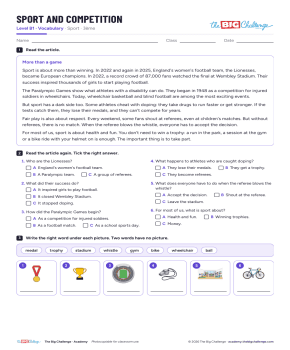
Champions, fans, doping and fair play: "More than a game" goes from the Lionesses at Wembley and the Paralympic Games to cheating, respect for referees and sport for fun. Pupils work through the words of sport and competition, from pictures and meanings to word forms and collocations, and end on a word search with a hidden message; answer key included.
Documents to download (2)
- Colour version In your teacher account
- Black and white version In your teacher account
Teaching guide
Objective & content
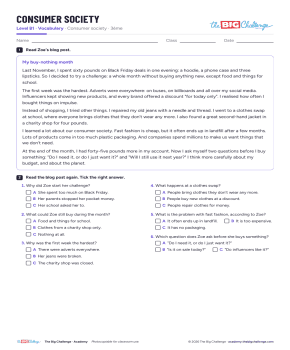
This sheet on sport and competition opens on a magazine article, "More than a game". In 2022 and again in 2025, England's women's football team, the Lionesses, became European champions, and a record crowd watched the 2022 final at Wembley; the Paralympic Games, which began in 1948 for injured soldiers in wheelchairs, show what athletes with a disability can do. The article then turns to doping, to respect for referees and to sport for health and fun. It carries all the target words in context, from champions, fans and inspire to cheat, doping, fair play and take part. By the end, pupils understand and use the words to talk about sport, competition and fair play, and to give an opinion ("I think doping is cheating because...").
Pedagogical guide
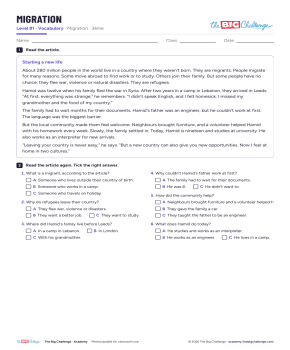
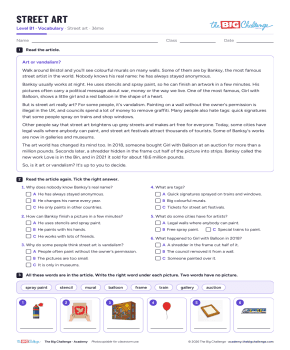
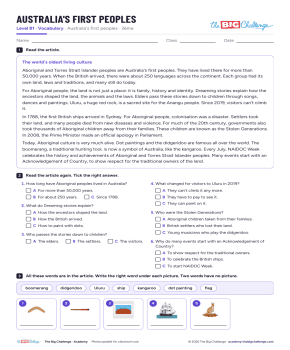
The vocabulary work comes out of the article, never from a list. Page 1 checks understanding with six multiple-choice questions, then pupils write the right word under six pictures from a box of eight (medal, trophy, whistle); two words have no picture. Page 2 matches eight words with their meanings (a record, to inspire, a disability, doping) and six collocations (win a medal, blow the whistle, accept the decision). Page 3 uses eight words from a box of ten in new sentences, with two extra words, and makes nouns with -ship (champion, championship), with a worked example and five items. It ends on a word search: pupils find sixteen words from the sheet across, down and diagonally, and the letters left over spell a hidden message, FAIR PLAY FOR ALL. Every task tests words, never grammar.
Suggested procedure
- (5 min) Ask pupils which sport they play or watch; write the sport words they know on the board.
- (15 min) Pupils read the article, answer the six questions and label the pictures.
- (10 min) Page 2: match the meanings, then the collocations.
- (15 min) Page 3: complete the eight sentences, make the nouns with -ship, then the word search.
- (10 min) Correct with the answer key on pages 4 and 5; pupils read out the hidden message.
Adaptations
[S] Read the article aloud together first; ask pupils which sport they play or watch.
[A] After the collocations, pupils write four sentences about a sports event they have seen.
Materials & prerequisites
One copy per pupil of the three pupil pages, in colour or black and white. Pages 4 and 5 are the answer key with teacher notes: keep them. Pupils should know the past simple, the present perfect, the first conditional, have to and relative clauses. To take it further, hold a class debate, "Is winning the most important thing?", where pupils give their opinion with I think... because....
Possible adaptations
- Lower levels: Offer segmented listening and additional visual aids.
- Advanced levels: Encourage an oral summary and a debate in English on the theme.
- Large groups: Organise group work with differentiated roles.
🔒 Restricted content
This resource requires a subscription to be viewed.
Unlock the resourceIncluded in the subscription