At the ticket office
Interactive exercises to consolidate your students’ learning.
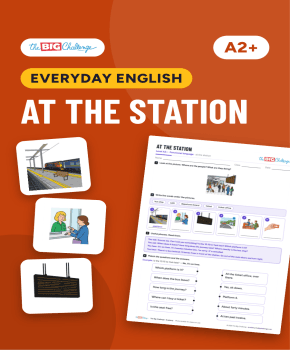
Buying a train ticket at the station, in a two-page pack: six words to label (train, bank card, coins, wallet, clock, stairs), the phrases to buy a ticket and ask about the train, a dialogue to complete, the Listen Up! episode "At the ticket office" (a QR code on the sheet plays it) and a role-play. Answer page included, in colour and in black and white. For A1+, one lesson of about 50 minutes.
Documents to download (2)
- Worksheet In your teacher account
- Worksheet (black and white) In your teacher account
Teaching guide
Objective & content
A two-page pack for one everyday situation: buying a train ticket at the station. Pupils learn the words (train, bank card, coins, wallet, clock, stairs) and the phrases to buy a ticket (A single to Oxford, please. How much is it?) and ask about the train (What time is the next train? Which platform is it?). Then they hear the same language in a real conversation, the Listen Up! episode "At the ticket office", and use it themselves in a role-play. By the end, they can buy a train ticket and find out when and where their train leaves.
Pedagogical guide
Page 1 is the language of the situation. Pupils talk about a picture of a girl and her mum buying tickets at a station ticket office, write six words under new drawings (the first is done), read a box of useful phrases (what you say or ask, and what you hear), and match five questions to their answers. Page 2 puts the language to work. Pupils complete a short dialogue with words from a box (Lily and her mum buying a ticket to Bath), then listen to the episode: Sam and his gran buy tickets to York, but their train is late, so they take a faster one. A QR code on the sheet plays the recording on a phone or a tablet, with no app and no login. Pupils tick true or false, listen again for four short answers, then do a role-play with A and B cards: a traveller buys a ticket from the clerk at a ticket office. Card B holds the information card A needs, so pupils have to ask. Every task opens with an example. Page 1 and the dialogue use other names, places and prices, so they never give away a listening answer. Page 3 is the answer key with the teacher notes.
Suggested procedure
- (5 min) Pupils look at the picture on page 1 and say where the people are and what they are doing.
- (5 min) Pupils write the words under the pictures; check together.
- (5 min) Pupils read the useful phrases aloud in pairs, one asking and one answering.
- (5 min) Pupils match the questions to the answers.
- (5 min) Page 2: pupils complete the dialogue with the words in the box.
- (10 min) Play the episode once for true or false, then again for the short answers.
- (10 min) Role-play in pairs with card A and card B, then pupils swap cards.
- (5 min) Check the answers with page 3.
Adaptations
[S] Pupils read the useful phrases aloud in pairs before the role-play, and keep page 1 in front of them while they play it. [A] Pupils invent their own problem in the same place and act it out without the cards.
Materials & prerequisites
One copy of pages 1 and 2 per pupil; cut out the role cards on page 2. Page 3 is the answer key: keep it. To play the episode, pupils scan the QR code with a phone or a tablet, or you play it to the class from the app (Listen Up!, "At the ticket office"). Pupils need numbers and prices, telling the time, and can for requests.
Possible adaptations
- Lower levels: Offer segmented listening and additional visual aids.
- Advanced levels: Encourage an oral summary and a debate in English on the theme.
- Large groups: Organise group work with differentiated roles.
🔒 Restricted content
This resource requires a subscription to be viewed.
Unlock the resourceIncluded in the subscription