Types of Pronouns
A striking visual aid to enrich your classroom.
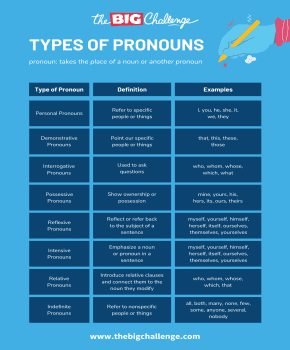
A3 classroom poster for A2: six types of pronoun (personal, possessive, demonstrative, interrogative, reflexive, indefinite), each with its job, its words and French hints.
Documents to download (1)
- Colour version Download
Teaching guide
Objective & content
This poster shows six types of pronoun, each with its job and its words: personal (I, you, he... me, him), possessive (mine, yours, hers), demonstrative (this, that, these, those), interrogative, reflexive (myself, themselves) and indefinite (someone, nothing). By the end, A2 students can name the type and replace a noun, as in Tom is tired. He wants to sleep.
Pedagogical guide
Use the poster as a reference table, not as a first lesson. Teach personal, possessive and demonstrative pronouns for active use, and treat reflexive and indefinite pronouns as recognition at A2. Check the possessive row with care: mine, yours replace a noun, whereas my, your come before one, and the poster states this only briefly. The poster covers only these six types.
Suggested procedure
- (5 min) Read the legend and the example Tom is tired. He wants to sleep. aloud.
- (10 min) Drill personal pronouns: dictate short sentences and students replace the nouns.
- (10 min) Contrast possessive and demonstrative pronouns: hold up near and far objects and elicit this / that / these / those.
- (5 min) Point to a reflexive or indefinite row and ask students for a sentence with one of its words.
Adaptations
[S] Focus on the personal and possessive rows and give a short list of pronouns to choose from.
[A] Students write a short text twice, once repeating nouns and once with pronouns, and compare the two.
Materials & prerequisites
Print at A3 portrait. Students need simple subject-verb-object sentences. French hints are printed on the poster; there are no exercises and no key.
Possible adaptations
- Lower levels: Offer segmented listening and additional visual aids.
- Advanced levels: Encourage an oral summary and a debate in English on the theme.
- Large groups: Organise group work with differentiated roles.