Valentine's Day
Interactive exercises to consolidate your students’ learning.
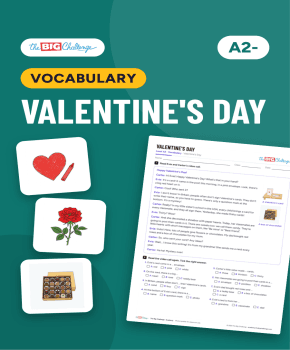
Valentine's Day in Britain and the USA through a short video call between two friends: Evie in England gets a card in a pink envelope with no name on it, only a question mark, because in Britain people often don't sign Valentine's cards, while in Carter's little sister's class in the USA every child makes a card with their name on it for every classmate. Pupils answer eight questions, name six pictures, complete five sentences and unscramble five Valentine's words, then make a card for a friend or someone in their family and write a short message on it with no name; answer key included.
Documents to download (2)
- Colour version In your teacher account
- Black and white version In your teacher account
Teaching guide
Objective & content
This sheet on Valentine's Day starts from a short video call between two friends, Evie in England and Carter in the USA. Evie has a card in a pink envelope with a big red heart on it, but there is no name, only a question mark: in Britain, people often don't write their name on Valentine's cards. Carter says that in his little sister's class, every child makes a card for every classmate, with their name on it, and there are candy hearts with little messages; Evie says that people often give flowers or chocolates, and then she knows the writing on her card: it is from her grandma. Two pictures sit beside the dialogue. Pupils answer eight multiple-choice questions, name six pictures from a box of eight words, complete five sentences and unscramble five Valentine's words. The sheet ends with a card that pupils make for a friend or someone in their family, with a drawing and a short message but no name.
Pedagogical guide
Evie and Carter compare the same day in two countries, so the words of the sheet come from that difference: a card with no name and a guess in Britain, thirty cards with names on them in Carter's sister's class. Every word that pupils name or write comes from the dialogue, and each box holds two extra words, so pupils choose rather than copy. The five sentences take the words out of Valentine's Day into everyday life, such as a secret birthday present or a cute puppy. The scrambled words have one answer each. Every task tests words, never grammar. The last two tasks are open: pupils make their own card and message, so their answers vary. The day stays a friendly one: Evie's card is from her grandma, and pupils write to a friend or someone in their family.
Suggested procedure
- (5 min) Ask what people do on 14 February in your country; write the words pupils know on the board.
- (10 min) Two pupils read the video call aloud; the class answers the eight questions.
- (10 min) Pupils name the six pictures with the help of the box.
- (10 min) Pupils complete the five sentences, then unscramble the five Valentine's words.
- (10 min) Pupils make their card, draw a picture on it and write a short message without their name.
- (5 min) Check with the answer key on page 4.
Adaptations
[S] Ask what people do on 14 February in your country.
[A] Pupils act out the video call in pairs. To take it further, pupils give their cards to a partner, who guesses who made each one.
Materials & prerequisites
One copy of the three pupil pages per pupil, in colour or in black and white; pupils need coloured pencils for the card. Page 4 is the answer key with teacher notes: keep it. Pupils should know the colours and family words such as mum, dad and grandma.
Possible adaptations
- Lower levels: Offer segmented listening and additional visual aids.
- Advanced levels: Encourage an oral summary and a debate in English on the theme.
- Large groups: Organise group work with differentiated roles.
🔒 Restricted content
This resource requires a subscription to be viewed.
Unlock the resourceIncluded in the subscription