Volunteering
Interactive exercises to consolidate your students’ learning.
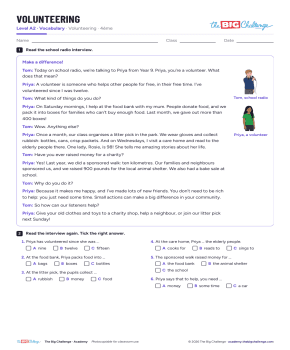
Volunteering and helping your community, through a school radio interview with Priya, who helps at a food bank, picks up litter in the park and reads to elderly people in a care home. Pupils answer questions, name ways to help, match meanings, make words for people with -er or -or and find 20 words in a word search; answer key included.
Documents to download (2)
- Colour version In your teacher account
- Black and white version In your teacher account
Teaching guide
Objective & content
This sheet on volunteering starts from a school radio interview: Tom talks to Priya, a Year 9 pupil who helps at a food bank, picks up litter in the park with her class and reads to elderly people in a care home. Pupils learn to talk about helping their community and to say what they have done ("I've volunteered since I was twelve"). They answer six multiple-choice questions, name six ways to help from a box of eight, match eight words such as charity, donate and sponsor with their meanings, complete seven sentences and add -er or -or to make words for people (help, helper). The sheet ends on a word search with 20 words and a hidden message.
Pedagogical guide
The interview carries the words of the topic, so pupils meet each one in context before working on it. Priya's examples are small and local (a food bank, a litter pick, a bake sale), so pupils can see what they could do themselves. The tasks go from recognising words to using them: pictures, meanings, sentences, then word forms. The -er / -or task asks for one kind of change only, with a worked example; point out the spelling (organise, organiser; run, runner). The word search gives the 20 words; they go across, down and diagonally, and the unused letters spell a message. Every task tests words, never grammar.
Suggested procedure
- (5 min) Ask "What is a volunteer?" and write pupils' ideas on the board.
- (10 min) Two pupils read the interview aloud; the class answers the six questions.
- (10 min) Pupils name the six pictures and match the eight words with their meanings.
- (10 min) Pupils complete the sentences, then read the worked example together and add -er or -or.
- (10 min) Pupils find the 20 words in the word search and read the hidden message.
- (5 min) Check with the answer key on pages 4 and 5.
Adaptations
[S] Before reading, list on the board what pupils already do to help others, at home or in their town.
[A] Pupils plan a class project to help the school or the town: who, what, when. To take it further, the class runs the project.
Materials & prerequisites
One copy of the three pupil pages per pupil, in colour or in black and white. Pages 4 and 5 are the answer key: keep them. Pupils should know the past simple and the present perfect with ever and since.
Possible adaptations
- Lower levels: Offer segmented listening and additional visual aids.
- Advanced levels: Encourage an oral summary and a debate in English on the theme.
- Large groups: Organise group work with differentiated roles.
🔒 Restricted content
This resource requires a subscription to be viewed.
Unlock the resourceIncluded in the subscription