What's missing?
A teaching resource designed to energise your English lessons.
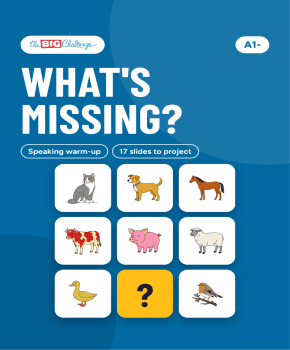
A projectable A1- memory warm-up: 8 rounds of nine pictures, such as animals, food, clothes and things at home. Pupils look, close their eyes, then say which picture has gone, with there is / there isn't and Is it the ...?
Documents to download (1)
- Slide bank In your teacher account
Teaching guide
Objective & content
By the end, A1- pupils can name everyday things from memory and say which one has gone, with there is / there isn't and Is it the ...?: The rabbit is missing! The bank is 17 projectable slides: a how-to slide, then 8 rounds of two slides each. The first slide of a round shows nine labelled pictures (animals, food, clothes, the classroom, toys and transport, the home); the second shows the same grid with one picture gone.
Pedagogical guide
Use it as a five-minute warm-up to revise core vocabulary. Looking at the nine pictures and saying them together is the practice; the missing picture gives every pupil a reason to remember the words. Because the class can guess wrongly first (Is it the dog? No, it isn't.), pupils use the question form as well as the word. The rounds are interchangeable: play one or two per lesson.
Suggested procedure
- (1 min) Show the how-to slide and read the example together.
- (1 min) Show the nine pictures. Pupils look and say the words together.
- (1 min) Pupils close their eyes. Show the next slide.
- (2 min) Pupils say what's missing. Play a second round if there is time.
Adaptations
- [S] Point at the pictures as the class says them, and give the first sound of the missing word.
- [A] Hide the screen and pupils write the nine words from memory, or a pupil chooses the missing word and the class asks Is it the ...?.
Materials & prerequisites
A projector or screen; the bank is a 16:9 PDF, one slide per page, with no printing needed. Assumes the words of the sets have been met once.
Possible adaptations
- Lower levels: Offer segmented listening and additional visual aids.
- Advanced levels: Encourage an oral summary and a debate in English on the theme.
- Large groups: Organise group work with differentiated roles.
🔒 Restricted content
This resource requires a subscription to be viewed.
Unlock the resourceIncluded in the subscription