The new girl
Interactive exercises to consolidate your students’ learning.
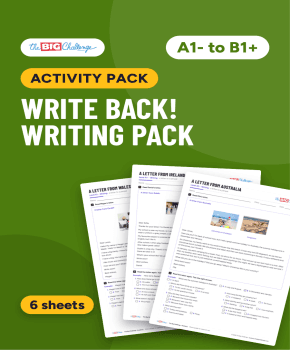
Writing a reply on a teen advice page, seen through a post from a fourteen-year-old who has moved to Glasgow and has no friends at her new school, and Jo's reply to another problem. Pupils answer questions on the post, match each part of Jo's reply to its words, read the useful phrases (You should, Why don't you, You might, If you... you'll), choose the best advice for five problems, then plan and write their reply to New Girl and tick a checklist; model reply and answer key included.
Documents to download (2)
- Worksheet In your teacher account
- Worksheet (black and white) In your teacher account
Teaching guide
Objective & content
This writing sheet teaches pupils to write a reply on an advice page (Thank you for your message, You're not the only one, You should..., Why don't you...?, You might..., Try talking to..., If you..., you'll..., When I was..., Good luck!). Pupils read a post from a teenager who has moved to a new school, read a model reply to another problem, see how it is built, take its phrases and write their own reply. By the end, they can write a reply of 120 to 150 words that gives advice and shares an experience.
Pedagogical guide
Page 1 has the post, signed "New Girl, 14", with a photo of a girl alone in a school corridor. She moved from Edinburgh to Glasgow in August and has been at her new school for three months, but she hasn't made any real friends yet. While she was waiting for the bus, she heard girls from her class talking about a party they invited everyone to except her. Her mum says she should join the drama club, but she is scared, and her best friend from Edinburgh hasn't answered her last two messages. She asks three questions: what should she do, should she join the drama club, and should she message her old friend again? Pupils answer six questions with three options each. Page 2 has Jo's reply to Sam, who spends too much time on his phone: pupils match each part (thank the writer, show you understand, first advice, say what will happen, more advice, end) to its words. The useful phrases follow in a box, and pupils tick the best advice for five problems. Page 3 is the writing: a plan in notes, the reply to New Girl (with Dear New Girl, already written and a row of phrases to use) and a checklist. The answer key gives a model reply. The advice uses should, might and the first conditional; If I were you is left for a later level.
Suggested procedure
- (5 min) Ask "What's hard about starting at a new school?" and collect ideas.
- (10 min) Read the post aloud; pupils answer the questions.
- (10 min) Page 2: read Jo's reply; pupils match its parts, then read the useful phrases.
- (5 min) Pupils tick the best advice for each problem.
- (20 min) Page 3: pupils plan in notes, write their reply and tick the checklist.
- (5 min) Pupils read out their best piece of advice; the class votes for the most useful.
Adaptations
[S] Pupils answer her three questions only, one short paragraph each.
[A] Pupils add a time they were new somewhere, with When I....
Materials & prerequisites
One copy of pages 1 to 3 per pupil. Page 4 is the answer key, the model reply and the teacher notes: keep it. Pupils need should, might, Why don't you...?, the first conditional, the present perfect with for and since, and the past continuous with while. To take it further, pupils write their own problems on cards, swap them and answer them.
Possible adaptations
- Lower levels: Offer segmented listening and additional visual aids.
- Advanced levels: Encourage an oral summary and a debate in English on the theme.
- Large groups: Organise group work with differentiated roles.
🔒 Restricted content
This resource requires a subscription to be viewed.
Unlock the resourceIncluded in the subscription