The label next to the portrait
Interactive exercises to consolidate your students’ learning.
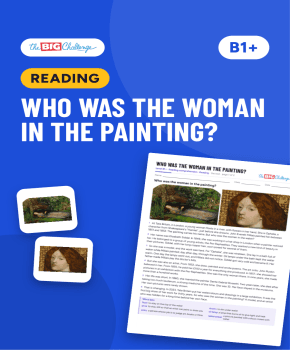
Writing the label that hangs next to a portrait in a museum, seen through Amira's label for Kehinde Wiley's portrait of Barack Obama (Amira is invented; the painting and the facts are real): a president on a wooden chair among leaves and flowers, chrysanthemums for Chicago, jasmine for Hawaii, blue lilies for Kenya. The painting is in copyright, so the sheet does not reproduce it: the teacher projects it. Pupils answer questions, read the useful phrases, describe and explain with stands for, as if and passive verbs, choose a card (a portrait of themselves, of someone they admire or of an invented person), plan four paragraphs and write a label of 150 to 180 words with a checklist; a model answer is in the key. About 50 minutes.
Documents to download (2)
- Worksheet In your teacher account
- Worksheet (black and white) In your teacher account
Teaching guide
Objective & content
A B1+ writing worksheet on portraits: the label that hangs next to a picture in a museum. The model is Amira's label for Kehinde Wiley's portrait of Barack Obama, shown at the National Portrait Gallery in Washington in February 2018 (Amira is invented, and the sheet says so; the painting and the facts are real): a president sitting on a wooden chair among leaves and flowers, with chrysanthemums for Chicago, jasmine for Hawaii and blue lilies for Kenya. By the end, pupils can describe a portrait, explain what its details stand for, and write a structured label with a personal conclusion.
Pedagogical guide
The painting is in copyright, so the sheet does not reproduce it: before page 1, project it from the page of the National Portrait Gallery (npg.si.edu). Page 1 gives Amira's label, six questions and the useful phrases in the order of the label (This portrait of ... was painted by ...; In the picture, ... is sitting; as if ...; Behind him, there is ...; Instead, ...; Each one stands for ...; For me, the portrait says that ...). Page 2 practises stands for, as if and the passive, then offers three cards: a portrait of me, of someone I admire, or of an invented person, so every pupil can do the task. It gives a four-paragraph plan, writing lines and a checklist. A model label for an invented person (Sam, 17) is in the key.
Suggested procedure
- (5 min) Project the portrait and ask: what can you see? Then read Amira's label together.
- (10 min) Pupils answer the six questions, then find each useful phrase in the label.
- (10 min) Page 2: describe and explain, then each pupil chooses a card and notes three details.
- (25 min) Pupils plan and write their label (150 to 180 words) and tick the checklist; or finish it as homework.
Adaptations
[S] Pupils write one or two sentences for each line of the plan.
[A] Pupils add a paragraph comparing their portrait with Wiley's.
Materials & prerequisites
The sheet in colour or low ink, two pupil pages and a key page with a model answer; a screen to project the portrait. Pupils should know the present simple and the present continuous, and have met the passive (was painted).
Possible adaptations
- Lower levels: Offer segmented listening and additional visual aids.
- Advanced levels: Encourage an oral summary and a debate in English on the theme.
- Large groups: Organise group work with differentiated roles.
🔒 Restricted content
This resource requires a subscription to be viewed.
Unlock the resourceIncluded in the subscription