Reading B1+: Why Do We Yawn When Other People Yawn?
Interactive exercises to consolidate your students’ learning.
A B1+ reading about contagious yawns: why we catch yawns most from family and friends, why dogs catch their owners' yawns, and what happens when you try not to yawn. One text with a word box, ten questions and a class experiment, catch a yawn, plus an answer key; 30 to 40 minutes.
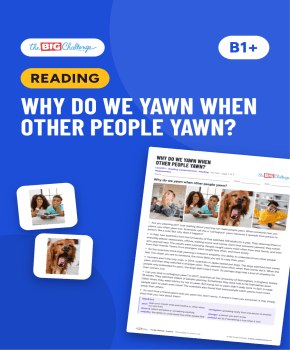
Documents to download (2)
- Reading comprehension In your teacher account
- Reading comprehension (black and white) In your teacher account
Teaching guide
Objective & content
A B1+ reading that may make your pupils yawn. The text asks why yawns spread from person to person, like a cold. In Italy, two scientists from the University of Pisa watched 109 adults for a year in everyday places: people caught yawns most often from their family, then from their friends, and less often from strangers. So yawning seems linked to empathy. In Japan, pet dogs yawned more when their owner yawned than when a stranger did. At the University of Nottingham, people told to try not to yawn wanted to yawn even more. The text ends warmly: catching a friend's yawn doesn't mean you are bored; it may show that you care. By the end, pupils can follow a short popular-science text, explain a result, and report on a small class experiment. It is part of the Reading B1+ set: one-text readings with the same layout.
Pedagogical guide
The sheet has one text of about 300 words at B1+, with no sentence longer than 20 words, and a word box with six words explained in English (yawn, contagious, observe, stranger, empathy, pretend). The ten questions go from finding information to explaining it: three choices or true or false first, then "Why do the scientists think that yawning is linked to empathy?" and "Did you yawn while you were reading this text?" The text models the passive (yawns from strangers were caught less often, they were told to try not to yawn), "the closer ..., the more likely ..." and "more likely to". The speaking task is a short class experiment: one pupil yawns and the others watch who catches it. Every fact comes from published research on yawning.
Suggested procedure
- (5 min) Warm-up: show the four photos and ask "Are you yawning yet? When do you yawn?"
- (10 min) Pupils read the text alone. They can use the word box.
- (10 min) Pupils answer questions 1 to 10, then check in pairs. Correct together with the key; for 9 and 10, take two or three answers.
- (10 to 15 min) Speaking task: the class tries an experiment: one pupil yawns in front of a group and the others watch who catches the yawn, and how quickly; each group talks about the results, then tells the class.
Adaptations
[S] Go through the word box first, with the photos. Before question 9, read paragraphs 2 and 3 again together. Pupils can answer questions 1 to 8 only, and say one sentence about the experiment.
[A] Pupils write up the class experiment like a scientist: what was done (in the passive), what was found, and one sentence with "the more ..., the more ...".
Materials & prerequisites
The sheet in colour or low ink (the low-ink version has no pictures), one copy per pupil: pages 1 and 2 are for pupils, page 3 is the answer key. A screen to show the photos for the warm-up. Pupils should know the past simple and have met the passive and comparatives.
Possible adaptations
- Lower levels: Offer segmented listening and additional visual aids.
- Advanced levels: Encourage an oral summary and a debate in English on the theme.
- Large groups: Organise group work with differentiated roles.
🔒 Restricted content
This resource requires a subscription to be viewed.
Unlock the resourceIncluded in the subscription