Short story: A Retrieved Reformation
Interactive exercises to consolidate your students’ learning.
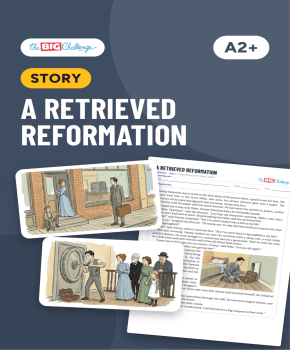
A Retrieved Reformation by O. Henry (1903), retold at A2+ with the story untouched: Jimmy Valentine, the best safe-breaker in the country, comes out of prison and goes straight back to his case of tools. Then, in a little town in Arkansas, he looks into the eyes of the banker's daughter and becomes another man, with a new name and an honest shop. But the detective Ben Price is on his trail, and one morning at the bank, Jimmy's old skills are the only thing that can save a child. Four pages of story with pictures, then six choice questions, four questions to think about the story, a box and gap fill on three verb forms from the story, and Ben Price's note to write; answer key and teacher notes included, in colour and in black and white. One long lesson or two short ones.
Documents to download (2)
- Worksheet In your teacher account
- Worksheet (black and white) In your teacher account
Teaching guide
Objective & content
A Retrieved Reformation by O. Henry (1903), retold at A2+. The language is simplified, the story is not: the ending is O. Henry's. Jimmy Valentine, a famous safe-breaker, comes out of prison and goes straight back to his hidden case of tools, and soon three safes are empty. The detective Ben Price knows whose work it is. Then, in the little town of Elmore, Jimmy sees Annabel Adams, the banker's daughter, and becomes another man: Ralph Spencer, the owner of the shoe shop. A year later, he is going to marry her, and he writes to an old friend to give away his tools. But Ben Price has found him, and on the morning Jimmy leaves town, a little girl gets locked inside the bank's new safe. By the end, pupils can follow a story of about 1,700 words and explain what Jimmy's choice at the bank costs him, and what it shows.
Pedagogical guide
The story runs over four pages, set like a novel, with one drawing on each page; Jimmy's letter is set in italics. Page 5 holds the tasks. Six choice and true or false questions check the story. "Think about the story" asks why Jimmy took a new name, why opening the safe was such a big decision, why he asked Annabel for her rose, and whether Ben Price was right to let him go. A box gives three verb forms from the story (the past perfect, "going to" for plans, and "said / told someone that" for reported speech), then pupils complete four sentences from the story with them. In the last task, pupils write Ben Price's note to his boss, explaining why he did not take Jimmy back to prison. Page 6 is the answer key with the teacher notes. The hero is a burglar, and the detective lets him go; a five-year-old girl is locked in the safe for a few minutes, and she comes out safe.
Suggested procedure
- (5 min) Ask "Can a person really change? Do you know a story where a bad character becomes good?"
- (20 min) Read the story aloud, or pupils read in pairs. Stop after "I'm not so sure about that!" and ask "What do you think Ben Price will do?" Stop again at the end of page 3 and ask "Who is the man? What will happen at the bank?"
- (10 min) Pupils answer the choice questions, then the "Think about the story" questions; check together.
- (10 min) Pupils read the box and complete the four sentences.
- (15 min) Pupils write Ben Price's note; a few pupils read theirs aloud.
Adaptations
[S] Read the story over two lessons, two pages at a time, and go through the words they may need first (prison, safe, burglar, tools, detective, strong room, drill). Pupils can answer the choice questions and two of the "Think about the story" questions only.
[A] Pupils write the letter Annabel writes to Ralph that evening: what did she see at the bank, and what does she want to ask him?
Materials & prerequisites
One copy per pupil, in colour or black and white: pages 1 to 5 are for pupils, page 6 is the answer key. Pupils should know the past simple.
Possible adaptations
- Lower levels: Offer segmented listening and additional visual aids.
- Advanced levels: Encourage an oral summary and a debate in English on the theme.
- Large groups: Organise group work with differentiated roles.
🔒 Restricted content
This resource requires a subscription to be viewed.
Unlock the resourceIncluded in the subscription