Agree or disagree?
A teaching resource designed to energise your English lessons.
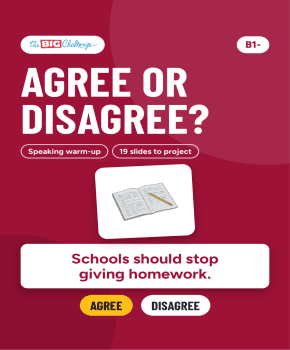
A projectable B1- speaking warm-up: 18 strong statements about school and teenage life, such as "Schools should stop giving homework". Pupils take sides, give reasons and answer someone who thinks the opposite.
Documents to download (1)
- Slide bank Download
Teaching guide
Objective & content
By the end, B1- pupils can give an opinion on a strong statement, support it with a reason and answer someone who thinks the opposite: I see your point, but ..., On the other hand, .... The bank is 19 projectable slides: a how-to slide, then 18 statements about school and teenage life (Schools should stop giving homework, Video games are a real sport), each with a small picture, an agree-disagree line and six opinion phrases.
Pedagogical guide
Use it as a five-minute warm-up that gets pupils taking sides. Each statement is written to split the class, and the phrases on every slide give pupils the language to reply politely to someone who disagrees, not just to state their own view. Moving to one side of the room makes everyone commit before they speak. The slides are interchangeable: show one or two per lesson.
Suggested procedure
- (1 min) Show the how-to slide and read the example together.
- (1 min) Show one statement. Pupils decide alone: agree or disagree.
- (3 min) Agree on one side of the room, disagree on the other. Each side gives reasons; anyone can change sides.
Adaptations
- [S] Pupils show where they stand on the line from 0 to 10 and say one reason with because.
- [A] Pairs: one pupil agrees and the other disagrees, even if they don't think so; or pupils write a new statement for the class to debate.
Materials & prerequisites
A projector or screen; the bank is a 16:9 PDF, one slide per page, with no printing needed. Assumes should / shouldn't and comparatives.
Possible adaptations
- Lower levels: Offer segmented listening and additional visual aids.
- Advanced levels: Encourage an oral summary and a debate in English on the theme.
- Large groups: Organise group work with differentiated roles.