Big questions
A teaching resource designed to energise your English lessons.
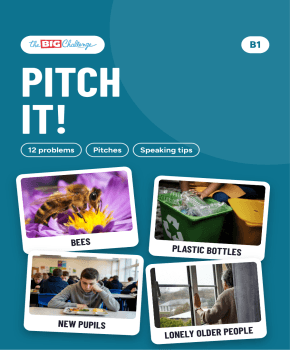
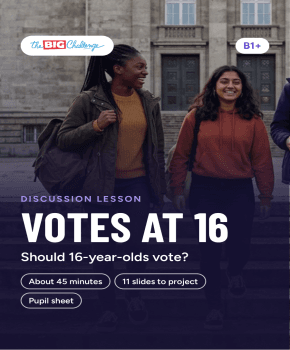
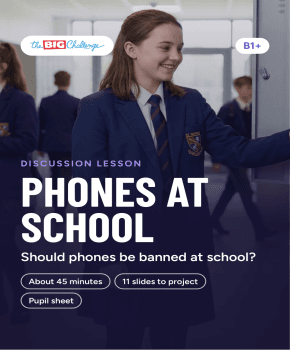
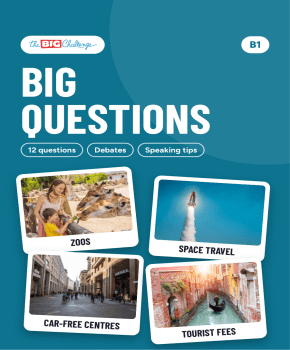
A debate pack of 12 big questions for teenagers: Should school start at 10am? Should zoos close? Should phones be banned at school? Should homework be banned? Is space travel worth the money? Should every pupil learn to cook at school? Should cars be banned from city centres? Should school uniform be compulsory? Should we stop eating meat? Should 16-year-olds be able to vote? Should tourists pay to visit famous cities? Should the school week be four days? Each card is a half page with a photo, a short context, three facts with their source, two arguments for and two against, two cards to a page to cut in half. The teacher gives each pair a question and a side, and they make their case in a two-minute talk. A speaking tips page gives a four-part talk and linking words, and a class grid keeps everyone listening and voting. 9 pages with a teacher page.
Documents to download (1)
- Fact files, speaking tips, listening grid In your teacher account
Teaching guide
Objective & content
A debate pack for B1 classes: twelve big questions teenagers have views on (Should school start at 10am? Should zoos close? Should phones be banned at school? Should homework be banned? Is space travel worth the money? Should every pupil learn to cook at school? Should cars be banned from city centres? Should school uniform be compulsory? Should we stop eating meat? Should 16-year-olds be able to vote? Should tourists pay to visit famous cities? Should the school week be four days?). Every card has the same parts: a short context, three facts with their source, two arguments for and two against, with a photo. Two cards share a page: print 6 pages and cut them in half. The teacher gives each pair a question and a side. By the end, pupils can give a short, structured argument, support it with a fact, answer the other side and react to a question they did not expect.
Pedagogical guide
Pupils argue the side they are given, not always the side they believe, so they focus on building an argument rather than on defending themselves. Each card gives real facts with a named source (studies, official bodies, real cities and countries, including France and Germany), and each talk must use at least one. The language is should / shouldn't, the present perfect with since (Phones have been banned since 2018), the first conditional (If school starts later, it finishes later), comparatives (more, less, fewer) and linking words (firstly, however, to sum up). The speaking tips page gives a four-part talk (your opinion / your reasons with one fact / the other side / sum up), useful phrases, three ways to answer a question you didn't expect and four tips. The class grid asks for the side, the best argument heard and a vote.
Suggested procedure
One or two lessons of about 50 minutes.
- (5 min) Read one question to the class and take a quick show of hands. Cut the card pages in half and give each pair a question and a side.
- (15 min) Pairs read their card and prepare a two-minute talk with the speaking tips page. They write key words on a card.
- (25 min) Pairs present their side. After each talk, the class asks one question. The class fills the grid with the side and the best argument, and votes after both sides of a question.
- (5 min) Pupils answer "Which talk changed your mind? Why?" with "Before, I thought ... Now I think ... because ...".
Adaptations
[S] Pairs use only the facts and the two arguments on their side, and read the four-part frame from the tips page.
[A] Pupils answer both arguments of the other side, or find one more fact of their own, with its source.
Materials & prerequisites
Print factfiles.pdf: the 6 card pages (pages 1 to 6, two cards a page, cut in half along the dashed line) so each pair has one question, the speaking tips page (page 7) and the class grid (page 8) for everyone; page 9 is the teacher page. Pupils should know should, the present perfect and the first conditional. Card 1 goes well with the B1+ reading on the teenage body clock; it also follows the A2 Famous lives and the A1 fact files.
Possible adaptations
- Lower levels: Offer segmented listening and additional visual aids.
- Advanced levels: Encourage an oral summary and a debate in English on the theme.
- Large groups: Organise group work with differentiated roles.
🔒 Restricted content
This resource requires a subscription to be viewed.
Unlock the resourceIncluded in the subscription